
Delhi's Silent Crisis: Over 500 Women Among 800 Missing in First 15 Days of 2026
Police data reveals a chilling start to 2026 for India's capital, with over 800 people reported missing in the first fortnight alone. Over 500 of them are women and girls. This article analyzes the alarming statistics, the police response, and the underlying socio-economic factors driving this disappearance crisis.
 frame and share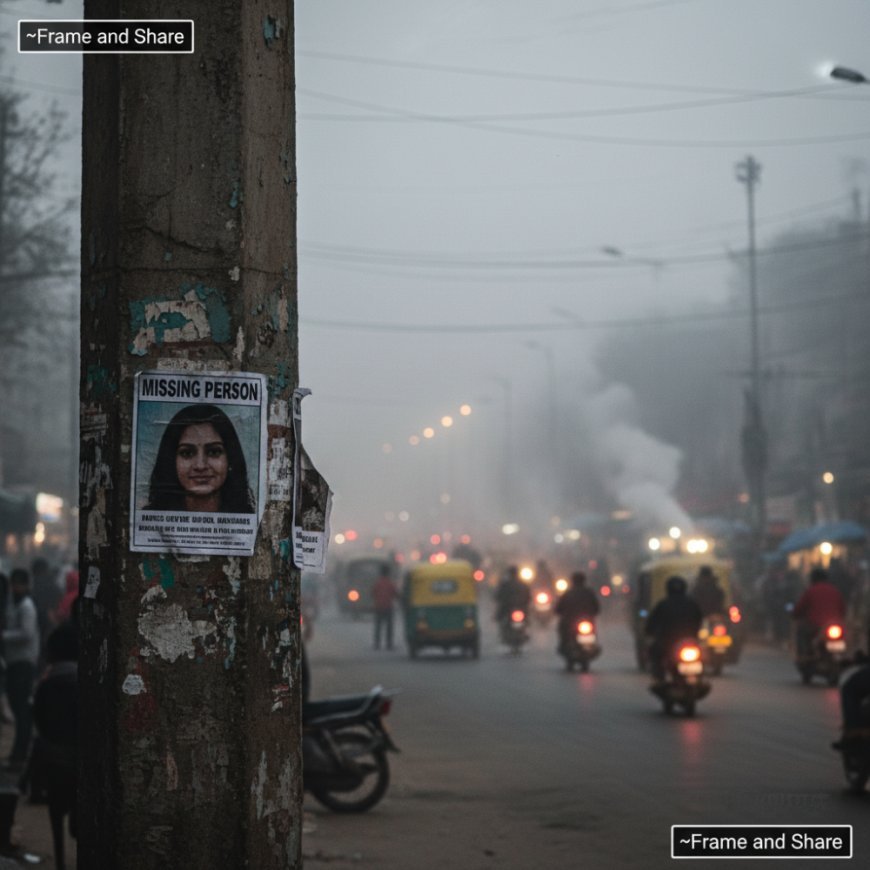


Vanishing in the Capital: The Silent Crisis of Delhi’s Missing Women
As the new year dawned, bringing with it the usual hopes and resolutions, a silent and terrifying crisis was unfolding in the heart of India’s capital. Between January 1 and January 15, 2026, Delhi witnessed the disappearance of 807 individuals. The raw numbers are staggering, averaging about 54 people vanishing from the city streets every single day. However, a closer look at the data released by the Delhi Police reveals an even more disturbing trend: the gendered nature of these disappearances. Of the 807 missing, 509 were women and girls accounting for nearly two-thirds of the total.
This wave of disappearances has reignited fierce debates about women's safety in a city that has long struggled to shed its reputation as unsafe for women. While the police have sought to contextualize the numbers as part of a stable decade-long trend, for the families of the missing, the statistics represent a living nightmare of uncertainty and fear.


The Anatomy of the Numbers
The data, accessible via official police records, paints a grim demographic picture. While men accounted for 298 of the missing cases, the vulnerability of women and female minors is starkly evident.


-
The Gender Gap: The statistic that 509 out of 807 missing persons are female highlights a disproportionate risk. This is not a random distribution but points to specific societal dangers that target women, ranging from domestic abuse and elopement to the darker realities of human trafficking and abduction.
-
Minors at Risk: Perhaps the most heart-wrenching subset of this data involves children. A total of 191 minors were reported missing in this short two-week window. Here too, the gender skew is undeniable. Out of these 191 children, 146 were girls, compared to just 45 boys.
-
The Teenager Crisis: Adolescents, specifically those aged between 12 and 18, appear to be the most vulnerable group. In the first fortnight of the year, 169 teenagers went missing. A staggering 138 of them were girls. The recovery rate for this demographic is worryingly low; police data indicates that nearly 71% of these teenage cases remain unresolved, with only 29 girls and 19 boys traced so far.
The Search for Answers: Traced vs. Untraced
While the reporting of a missing person is the first step, the recovery is the ultimate goal. The data shows a significant lag in tracing these individuals. Out of the 807 people reported missing, law enforcement agencies have managed to trace only 235 individuals. This leaves 572 people hundreds of souls still unaccounted for in just a two-week period.
The gap in tracing is particularly concerning when looking at the adult demographic. While adults constitute the largest share of missing persons (616 total), a vast majority (435) remain untraced. The reasons for adult disappearances are often complex, involving voluntary departures due to financial debt, family disputes, or mental health issues, but the high number of untraced women (363 reported missing) suggests that involuntary factors cannot be ruled out.
A Decade of Disappearances
The alarming start to 2026 is, unfortunately, not an anomaly but a continuation of a persistent trend. A decadal analysis of Delhi Police records from 2016 to 2026 shows that over 2.3 lakh people have gone missing in the city. While the police have a decent track record of tracing individuals locating about 1.8 lakh people over the decade nearly 52,000 cases remain unresolved.
The year 2025 was particularly grim, recording over 24,500 missing persons cases. Consistent with the current data, women accounted for over 60% of those cases (14,870). The consistency of these figures suggests systemic issues that go beyond temporary spikes in crime. It points to a deep-rooted ecosystem where individuals, particularly women and children, can slip through the cracks of society with alarming ease.
The Police Perspective: "No Significant Surge"
In response to the public outcry following the release of this data, the Delhi Police issued a clarification stating that there has been "no significant surge" in missing persons cases. They argue that the numbers are consistent with monthly averages seen over the past few years. Typically, around 2,000 people are reported missing in Delhi every month.
The police emphasize that "missing" does not always equal "crime." In a bustling metropolis like Delhi, which sees massive influxes of migrants and has a high population density, people lose contact for various reasons. Adults may leave homes voluntarily due to domestic discord or illicit relationships. Children might run away to escape academic pressure or abuse. However, officials also acknowledge the existence of organized crime syndicates that prey on the vulnerable.
To combat this, the police have deployed initiatives like "Operation Milap," which focuses on reuniting missing children with their parents, and face-recognition technology to match found individuals with missing person databases (ZIPNET). Despite these efforts, the sheer volume of cases often overwhelms the system.
The Darker Underbelly: Trafficking and Exploitation
Social activists and NGOs working on the ground argue that dismissing these numbers as "routine" ignores the dangerous reality of human trafficking. Delhi serves as both a destination and a transit hub for trafficking networks.
-
The Demand for Labor and Marriage: Young girls from impoverished backgrounds are often lured with promises of jobs in the city, only to be sold into domestic servitude or forced marriages in states with skewed sex ratios.
-
The "Lover Boy" Method: For teenagers, the threat often comes in the form of grooming. Traffickers or predators target adolescent girls, often via social media or local acquaintances, luring them away from safety under the guise of romance or elopement.
-
Economic Distress: The post-pandemic economic landscape has left many families in financial ruin. In such desperate times, adults may abandon their families to escape debt, or worse, children may be handed over to "agents" in hopes of a better life, only to disappear into the fold of organized begging or labor rackets.
The Political Fallout
The statistics have inevitably taken a political turn. Opposition leaders and former officials have seized upon the data to criticize the current administration's handling of law and order in the capital. Former Delhi Chief Minister Arvind Kejriwal expressed deep concern on social media, stating that the safety of citizens seems to be "left to the mercy of God." He questioned why, despite the central government's control over the Delhi Police, the city remains so unsafe for its women and children.
This political blame game, however, offers little solace to the families waiting for their loved ones. For them, the issue is not about jurisdiction but about the fundamental right to safety.
The Way Forward
Addressing the crisis of Delhi's missing people requires a multi-pronged approach that goes beyond filing FIRs.
-
Technological Integration: While tools like ZIPNET exist, there is a need for better integration of data across state lines. Traffickers often move victims across borders quickly; a unified, real-time national database is crucial.
-
Community Policing: Strengthening community vigilance systems can prevent abductions. Local "eyes and ears" are often the most effective deterrent against traffickers operating in slums and unauthorized colonies.
-
Sensitization and Support: The stigma associated with missing women often leads to delays in reporting. Families fear social judgment if a daughter has "eloped." Police and social workers need to work on destigmatizing reporting so that investigations can begin during the "golden hour" the first 24 to 48 hours after a disappearance.
As 2026 progresses, the hope is that these 800 names do not just become another statistic in a dusty file. Each number represents a life interrupted, a family broken, and a question that demands an answer: In a city of millions, how do so many simply vanish into thin air?