Court Speaks, Government Sleeps: Who Will Unlock Waqf Justice?
Bombay High Court's directive for timely Waqf justice faces state non-compliance due to an incomplete Tribunal, causing prolonged delays in crucial adjudications.
 frame and share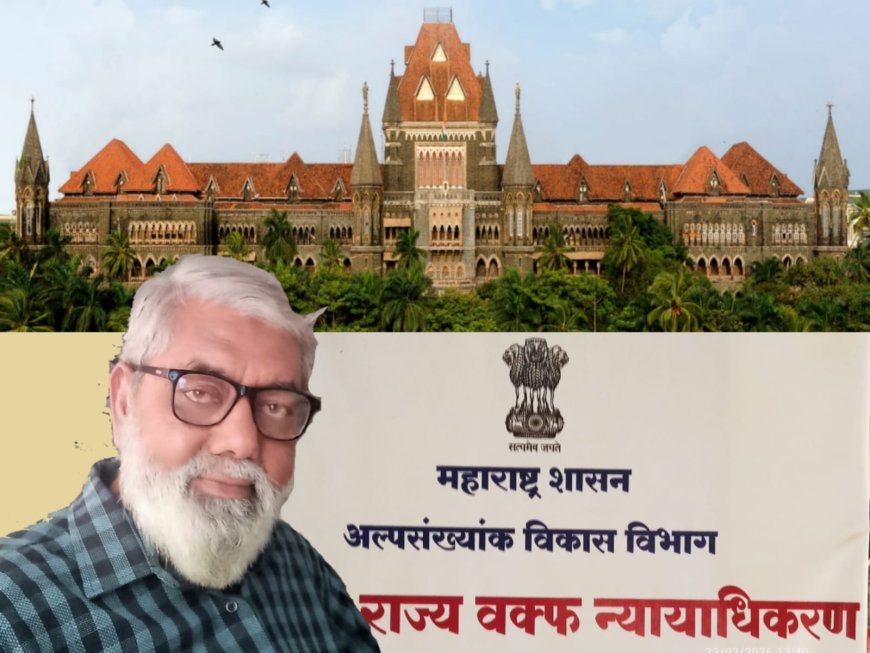


The question as to whether adjudication in Waqf matters in the State of Maharashtra is being unduly delayed is no longer a matter of public discourse alone; it now forms part of the judicial record before the Bombay High Court. In Writ Petition No. 3028 of 2023 (Shakir M. Ibrahim vs. State of Maharashtra & Ors.) along with connected Writ Petition Nos. 853 of 2024, 955 of 2024, 1069 of 2024, 1412 of 2024, 1124 of 2024 and 3359 of 2023, the Division Bench comprising Hon’ble Justice Bharati Dangre and Hon’ble Justice Manjusha Deshpande has been apprised of a situation which raises serious concerns regarding the effective implementation of statutory and judicial mandates.
By order dated 3 April 2025, the High Court issued a clear and time-bound direction that proceedings instituted under Section 7 of the Waqf Act be decided within a period of three months. The said direction, being binding in nature, required prompt administrative compliance to ensure that the Waqf Tribunal was duly constituted and rendered functional in accordance with law. However, the material placed on record indicates that the Tribunal continues to remain incompletely constituted, thereby impeding the adjudicatory process and resulting in continued pendency of matters.
It is a matter of record that the appointment of one of the members came to be cancelled by notification dated 9 October 2025. While such cancellation falls within the administrative domain of the State, the consequential obligation to ensure the immediate appointment of a substitute member so as to maintain the quorum and functionality of the Tribunal assumes critical importance. In the absence of a complete Bench, the Tribunal is rendered incapable of effectively discharging its statutory functions, which in turn adversely affects the rights of litigants seeking adjudication of their disputes.
The proceedings further indicate that the State has sought time on more than one occasion for compliance. By order dated 17 February 2026, further time was granted, and the matter has been directed to be listed on 9 March 2026 for the State’s response. The issue, therefore, is not merely administrative delay but the larger question of ensuring compliance with judicial directions and preserving the efficacy of a statutory adjudicatory mechanism.
The continued non-functioning of the Tribunal has a direct bearing on the right of the parties to seek timely adjudication of their claims. Access to justice and expeditious disposal of disputes are integral facets of the rule of law. Any prolonged vacancy in a statutory tribunal, particularly after a specific judicial mandate, gives rise to concerns regarding institutional accountability and governance.
The matter also assumes significance in the context of legislative oversight. The ongoing Budget Session of the State Legislature provides an appropriate constitutional forum where issues relating to the functioning of statutory bodies, implementation of court orders, and protection of legal rights may be raised and addressed.
At present, the position that emerges is that despite a binding judicial direction, completion of pleadings and arguments by the parties, and the acknowledged requirement of a fully constituted Tribunal, the process of appointment of the third member remains pending. The situation warrants expeditious action so as to restore the functionality of the Tribunal, ensure compliance with the order of the High Court, and uphold the confidence of litigants in the adjudicatory process.
The appointment of the third member prior to the next date of hearing, i.e., 9 March 2026, would be in consonance with the principles of good governance, constitutional responsibility, and the mandate of the Court. Failure to do so may necessitate further judicial intervention.
The issue, therefore, transcends a mere administrative formality and touches upon the broader principles of rule of law, separation of powers, and the State’s obligation to ensure that statutory forums created for adjudication of rights remain functional and effective.
Dr. Riyaz Deshmukh ACP (Rtd), Chhatrapati Sambhajinagar- 8888836498