
What the Police Should Be in a Democracy
 frame and share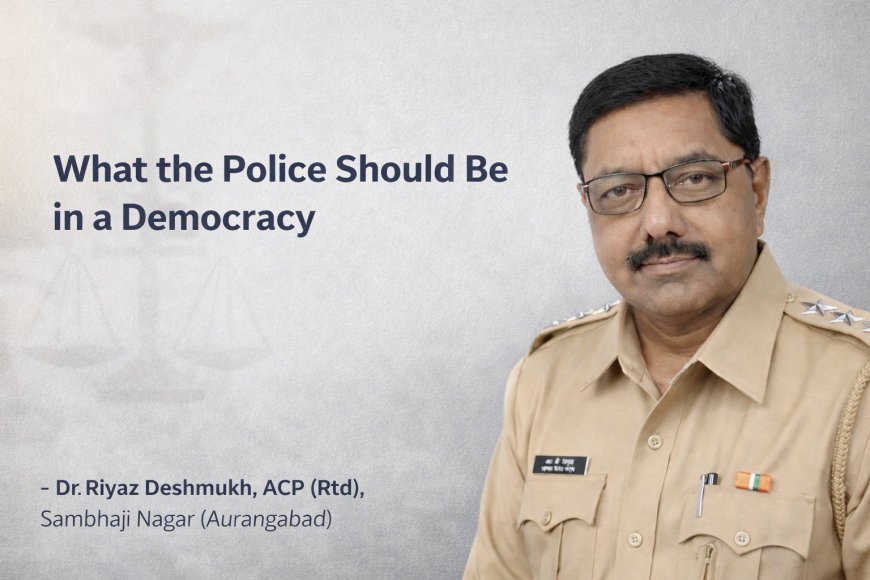


In a constitutional democracy, the police are not rulers, not agents of the government of the day, and not tools of political power. The police are servants of the Constitution and the people. Their authority comes from the law, and their purpose is to protect citizens, not to control or frighten them. A democratic police force exists to ensure safety, justice, and peace while respecting the dignity of every individual.
The police must always work within constitutional limits. They are expected to respect the rule of law, fundamental rights, and due process. They cannot act on illegal verbal orders, political pressure, or personal anger and bias. Their loyalty must be to the law and the Constitution, not to individuals who hold power temporarily. When police act outside the law, democracy itself becomes weaker.


One of the most important duties of the police is to protect the fundamental rights of people. This includes the right to life and personal liberty, freedom of speech, the right to peaceful protest and assembly, and equality before the law. Illegal arrests, torture, custodial violence, or targeting certain groups unfairly are not only wrong but also against democratic values and human rights principles. The police should be a shield for citizens, not a source of fear.


In a democracy, the police must remain politically neutral. The law should apply equally to powerful individuals and ordinary citizens. There should be no favoritism, no revenge, and no ideological bias in law enforcement. Justice must be fair and impartial. When police act selectively or under political influence, public trust breaks down and the rule of law is damaged.
Police are accountable to the law, not to rulers. Their actions can be reviewed by independent courts, oversight bodies, internal disciplinary systems, and public scrutiny through media and civil society. This accountability ensures that police power is not misused. A democratic police system accepts that authority must always come with responsibility and transparency.
Modern democratic policing is based on public service. It emphasizes community policing, openness, and building trust between the police and the public. The idea is that policing works best when it is done with the consent of the people. The goal is to create confidence and cooperation, not fear and intimidation. A police officer should be seen as a helper and protector.
Some countries are often noted for stronger democratic policing practices. In the United Kingdom, the idea of “policing by consent” guides the system, supported by strong judicial oversight and independent bodies that investigate police misconduct. Canada follows strict protection of rights under its Charter, with regular court review and high transparency. In Germany, police are strictly bound by constitutional law, supported by a strong human rights culture and real punishment for misuse of force. New Zealand focuses on community-centered policing with minimal political interference and high ethical training. Norway is known for very high accountability, rare use of force, and deep respect for human dignity.
India is constitutionally a strong democracy, but policing often struggles to meet these ideals. Reasons include a colonial-era policing mindset, political interference in transfers and investigations, weak implementation of police reforms ordered by the Supreme Court, and low accountability in cases of custodial abuse. Indian courts have repeatedly stated that the police must be loyal to the Constitution and not to politicians, but this principle is not always fully followed in practice.
In a true democracy, police power comes from the Constitution, and its purpose is to protect citizens, not to suppress them. The police are not a private army of the state or political leaders. They are a public institution meant to defend rights, uphold the law, and serve society with fairness, responsibility, and respect for human dignity.
- Dr Riyaz Deshmukh, ACP (Rtd), Sambhaji Nagar (Aurangabad)