Modi's "Friendship" Diplomacy Wins: Goyal Hails Historic US-India Trade Pact as "Best Deal" in Region
Union Minister Piyush Goyal credits PM Modi's personal rapport with Donald Trump for securing a "historic" trade deal that lowers US tariffs to 18% while protecting India's dairy and agriculture sectors. Read the full analysis of the deal and the political showdown it has sparked.
 frame and share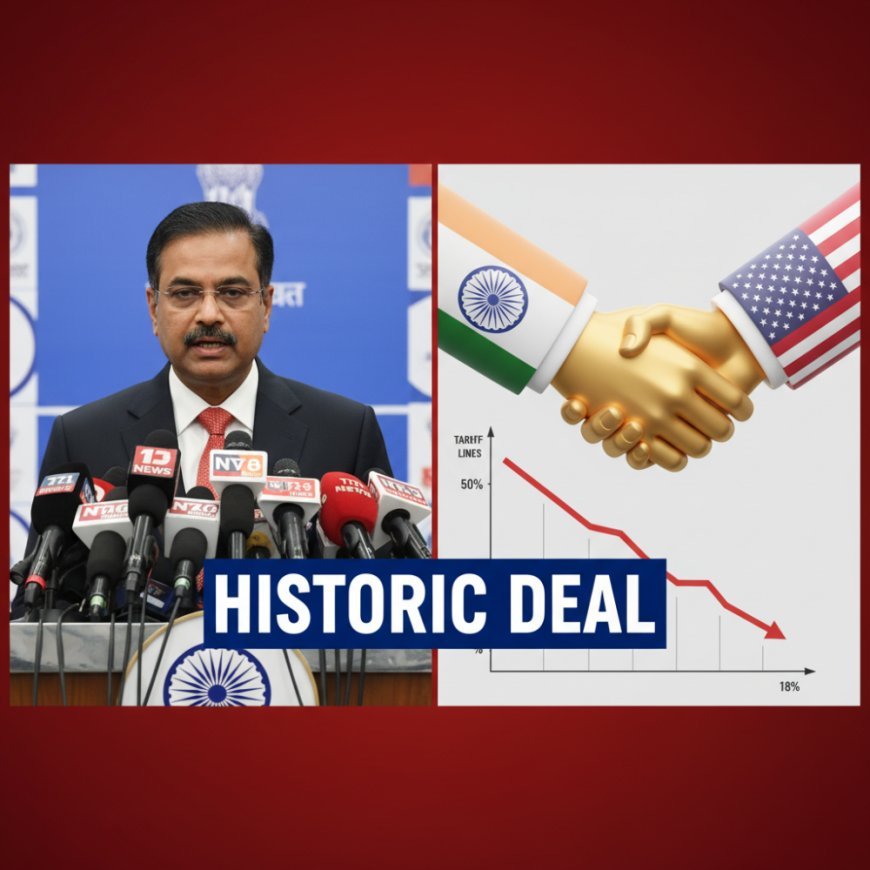


New Delhi: In a resounding endorsement of Prime Minister Narendra Modi’s diplomatic strategy, Union Commerce Minister Piyush Goyal on Tuesday termed the newly finalized trade agreement between India and the United States as the "best deal" New Delhi could have secured, far outpacing the terms received by neighboring nations and economic competitors.
Addressing a packed press conference a day after US President Donald Trump publicly announced the pact, Goyal emphasized that the breakthrough was not merely a result of bureaucratic negotiation but a direct outcome of the "friendly relationship and close ties" shared between PM Modi and President Trump.


The "Best Deal" Narrative
The core of Goyal's address focused on the comparative advantage India has gained through this agreement. Under the new terms, the United States has agreed to slash its reciprocal tariffs on Indian goods from a punitive high of 25-50% down to a flat 18%.
"We all know that the Prime Minister, leveraging his friendly relationship and close ties with President Trump, has finalized a trade deal with the United States of America that is the best deal India has received compared to all our neighbors, all the surrounding countries, and all the countries that compete with us," Goyal stated.
The Minister's assertion is backed by the fact that other regional manufacturing hubs continue to face steeper barriers. While India now enjoys an 18% tariff line, competitors like Vietnam (20%), Bangladesh (20%), and China (approx. 34-50%) remain subject to higher duties. This differential is expected to give Indian exporters—particularly in textiles, leather, and gems & jewelry—a significant competitive edge in the lucrative American market.
Protecting the "Holy Cows": Agriculture and Dairy
A critical aspect of the negotiations was the protection of India's sensitive sectors. For months, opposition parties and farmer unions have expressed apprehension that a trade deal with the US would open the floodgates for American dairy and agricultural products, potentially decimating the livelihoods of millions of Indian farmers.
Goyal moved swiftly to dispel these fears, categorically stating that the government has "completely protected" the interests of the agriculture and dairy sectors.
"The Prime Minister is constantly concerned about our farmers, those associated with animal husbandry, and the dairy sector. He has never allowed their interests to be compromised," Goyal asserted. He drew a parallel to PM Modi’s decision to walk out of the Regional Comprehensive Economic Partnership (RCEP) years ago, citing it as proof of the government's commitment to protecting domestic producers from unfair foreign competition.
While the full text of the joint statement is pending, government sources indicate that while India may open its markets to non-competing American agricultural products like nuts (almonds, walnuts) and berries, the "sensitive" core of dairy and staple grains remains shielded from zero-duty imports.
The Politics of Announcement: Who Spoke First?
The press conference was also charged with political fireworks, particularly regarding the sequence of the announcement. Opposition leaders, including Congress General Secretary Jairam Ramesh, had criticized the government for allowing President Trump to announce the deal on social media before the Indian Parliament or public were informed, labeling it "Trump-nirbharta" (dependence on Trump).
Goyal offered a technical rebuttal to this political attack. He explained that since it was the United States that had imposed the "reciprocal tariffs" in the first place, it was procedurally appropriate for the US President to announce their reduction.
"The US tweeted first because they had levied reciprocal tariffs that they had to lower," Goyal clarified. "When the US had applied reciprocal tariffs and they had to roll those back, this information would come from the US only."
Goyal vs. Gandhi: The Parliament Showdown
The Minister did not mince words when addressing the opposition's conduct. He claimed that the government intended to make a formal statement regarding the trade deal on the floor of the Parliament but was prevented from doing so due to disruptions caused by the opposition.
Training his guns on the Leader of the Opposition, Goyal said, "We wanted to speak in Parliament, but the entire country saw the kind of disgraceful behavior Rahul Gandhi displayed in the House." He accused the Congress and its allies of deliberately stalling proceedings and insulting the Lok Sabha chair, thereby forcing the government to brief the media instead of the legislature.
Economic Implications: A "Historic Turning Point"
Beyond the political rhetoric, the deal signals a major shift in Indo-US economic relations. Goyal described the agreement as a "historic turning point" that will accelerate India's journey towards becoming a developed nation (Viksit Bharat) by 2047.
Key takeaways for the Indian economy include:
-
Technology Transfer: The deal is expected to facilitate the flow of high-end US technology into India, crucial for the semiconductor and defense sectors.
-
MSME Boost: Lower tariffs in the US will directly benefit India's labor-intensive MSME sector, which forms the backbone of the country's exports.
-
Global Value Chains: By aligning closer with the US and distancing from Russian energy (a reported condition of the deal), India is positioning itself as a reliable partner in Western supply chains, dubbed "friend-shoring."
As India awaits the formal joint statement that will ink the technical details, the government's message is clear: personal diplomacy has delivered a pragmatic economic victory. By securing an 18% tariff rate lower than any of its rivals New Delhi has managed to turn a potential trade war into a competitive advantage, all while claiming to safeguard its most vulnerable agricultural communities. However, with the opposition crying "surrender," the domestic political battle over the deal's fine print is just beginning.