Post-Budget Hope: Will RBI’s Feb 6 Announcement Finally Slash EMIs for the Common Man?
After the Union Budget 2026, all eyes are now on the RBI's Monetary Policy Committee meeting. On February 6, Governor Shaktikanta Das may announce a decision on the Repo Rate. Will home loan EMIs finally go down? Read the detailed analysis.
 frame and share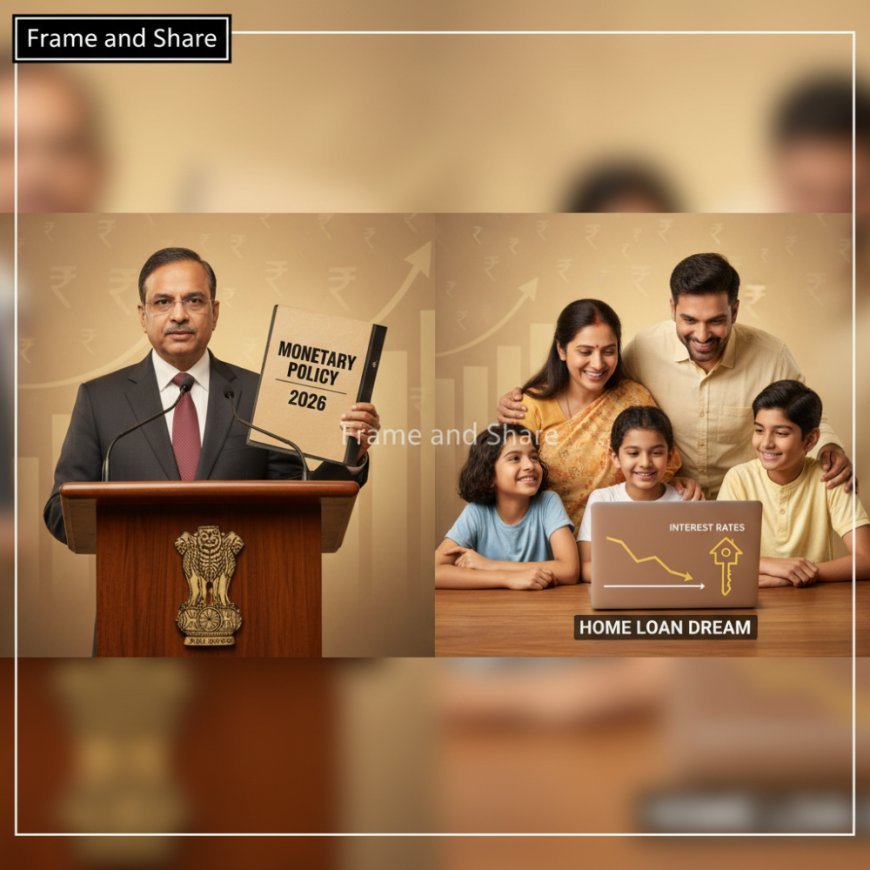


The Second Big Event of February
The dust has barely settled on the Union Budget 2026, presented by the Finance Minister on February 1st. While the Budget laid out the government's fiscal roadmap focusing on infrastructure, defense, and long-term growth many in the middle class (the "Aam Aadmi") were left scanning the fine print for immediate relief in their pockets.
Now, the focus shifts to Mumbai. The second most critical economic event of the month is scheduled for February 6, 2026. This is when the Reserve Bank of India (RBI) Governor, Shaktikanta Das, will announce the decision of the Monetary Policy Committee (MPC). For the common man, burdened by high interest rates on home and car loans over the past few years, this date holds the promise of the relief that the Budget may have overlooked: a reduction in EMIs.


What is Happening on February 6?
The RBI’s Monetary Policy Committee, a six-member panel entrusted with setting India's benchmark interest rates, began its three-day deliberation shortly after the Budget. On the morning of February 6, the RBI Governor will hold a press conference to reveal the outcome of these meetings.


The core question on everyone’s mind is: Will the RBI cut the Repo Rate?
The Repo Rate is the interest rate at which the RBI lends money to commercial banks. It acts as the gravitational center for the entire banking system.
-
If Repo Rate goes UP: Banks pay more to borrow, so they charge you more. Loans become expensive.
-
If Repo Rate goes DOWN: Banks borrow cheaply, and usually pass this benefit to consumers. Loans become cheaper, and EMIs drop.
Why the "Common Man" is Watching
For the last two years, central banks globally, including the RBI, have maintained a "hawkish" stance (keeping rates high) to fight the monster of inflation. While this successfully prevented prices from spiraling out of control, it resulted in a painful side effect: soaring EMIs.
Home loan interest rates, which were once hovering around 6.5% to 7%, climbed to nearly 9% or higher. For a middle-class family paying off a 20-year home loan, this increase added thousands of rupees to their monthly outgo or extended their loan tenure by years.
The February 6 announcement is significant because economic indicators suggest the tide may finally be turning. With inflation largely within the RBI’s tolerance band (4% +/- 2%) and the government demonstrating fiscal prudence in the recent Budget (keeping the fiscal deficit in check), the room for a rate cut has opened up.
The Budget Connection: Why This Meeting is Different
The Union Budget and the RBI Policy are two wheels of the same chariot.
-
Fiscal Prudence: In the 2026 Budget, the government resisted the urge to overspend, sticking to a strict fiscal consolidation path. This implies that the government will borrow less from the market.
-
Lower Bond Yields: When the government borrows less, bond yields drop, and the pressure on the central bank eases.
-
Green Signal for RBI: Financial experts argue that since the government has done its part by not fueling inflation through excessive spending, the RBI can now focus on supporting growth by lowering interest rates.
Therefore, the expectation for the February 6 meeting is higher than it has been in previous months. The "Common Man" is hoping that the RBI acknowledges the government's discipline and rewards the economy with a rate cut.
The Scenarios: What Could Shaktikanta Das Announce?
Market analysts and economists are divided into three camps regarding the February 6 outcome:
Scenario 1: The "Good News" (Rate Cut of 25 bps)
This is the most optimistic scenario. The RBI cuts the Repo Rate by 25 basis points (0.25%).
-
Impact: Banks would likely lower their Marginal Cost of Funds Based Lending Rate (MCLR).
-
Result: Your home loan EMI could decrease, or your loan tenure would shorten. It would also boost sentiment in the real estate and auto sectors.
Scenario 2: Change in Stance (Neutral)
The RBI might keep the rate unchanged but change its official "stance" from "Withdrawal of Accommodation" to "Neutral."
-
Impact: This is a signal that "Winter is over." While rates won't drop immediately on Feb 6, it guarantees a cut in the next meeting (April).
-
Result: Markets will rally, and banks might start preemptively softening rates.
Scenario 3: Status Quo (No Change)
The RBI remains cautious, citing global uncertainties (like oil prices or geopolitical tensions).
-
Impact: Disappointment for borrowers. High EMIs continue for another two months.
Beyond EMIs: Impact on Savings
It is important to note that the coin has two sides. While a rate cut is great news for borrowers, it is often bad news for depositors, particularly senior citizens who rely on Fixed Deposit (FD) interest.
If the RBI cuts rates on February 6, banks may also lower the interest rates they offer on FDs and savings accounts. The "Common Man" who is a saver rather than a borrower might see a slight dip in their interest income. However, usually, there is a lag—banks are quick to cut deposit rates but slow to cut lending rates. The RBI will likely urge banks to ensure fair transmission of rates.
What Should You Do?
As we approach February 6, here is what the common man should keep in mind:
-
Don't Panic: If there is no cut, remember that the cycle has peaked. Rates are unlikely to go up further.
-
Check Your Loan Spread: If the RBI cuts rates but your bank doesn't lower yours, check if you are on an old regime (Base Rate) or the new one (EBLR). Switching to an External Benchmark Linked Rate (EBLR) ensures your loan moves in tandem with the RBI Repo Rate.
-
Watch the Governor’s Speech: Often, the commentary on future inflation is more important than the current decision. If Governor Das sounds confident about controlling prices, relief is imminent.
February 6 promises to be a decisive day for the Indian economy. While the Union Budget sets the long-term vision, the RBI’s policy dictates the immediate monthly cash flow of millions of Indian households.
Whether it is a direct rate cut or a strategic change in stance, the expectation is that the RBI will offer a soothing balm to the middle class. After years of high interest, the "Aam Aadmi" is waiting for the signal that the EMI burden will finally ease, allowing them to participate more freely in India's growth story.