Russia Claims '100% Cure' with New Cancer Vaccine Enteromix: Hope or Hype?
Breaking News: Russia announces its new cancer vaccine, 'Enteromix,' is ready for clinical use, claiming a 100% success rate in trials. Medical experts remain skeptical due to a lack of data. Read the full report.
 frame and share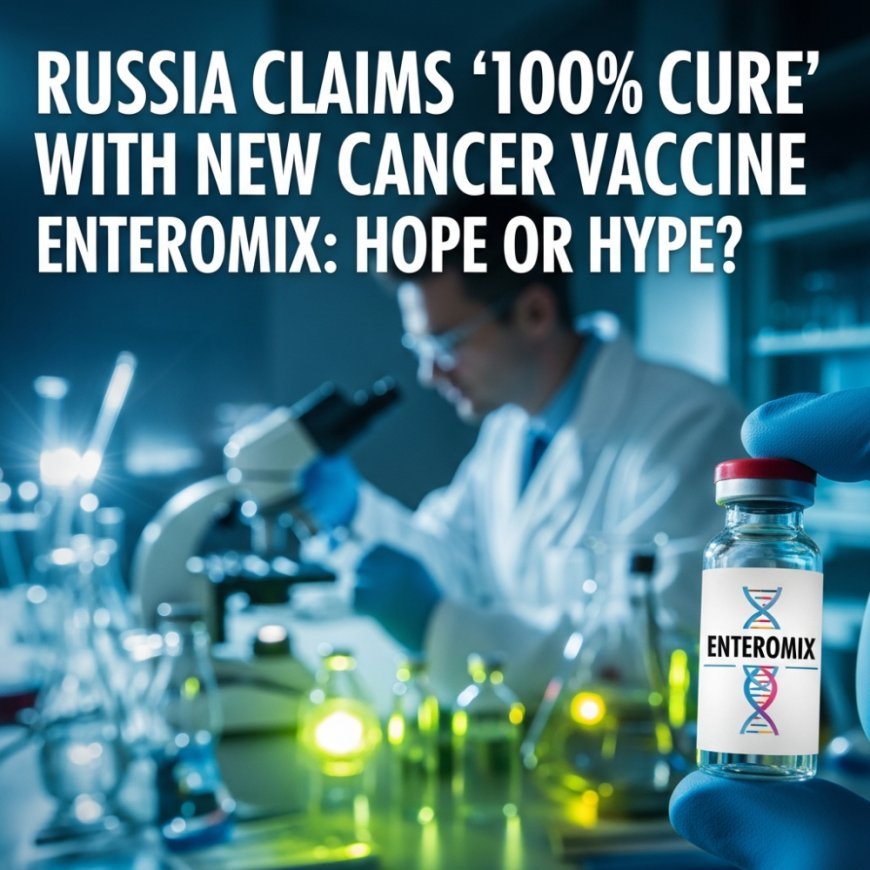


Medical Miracle or Political Hype? Russia Announces '100% Success' with New Cancer Vaccine Enteromix
Moscow: In a stunning announcement that has sent shockwaves through the global medical community, Russian health officials have declared that their new cancer vaccine, "Enteromix," is ready for clinical use. The most controversial aspect of this revelation is the claim that the treatment demonstrated a 100% success rate during reported clinical trials.




If validated, this development would represent the "Holy Grail" of oncology—a universal or near-universal cure for a disease that kills millions annually. However, without public data or independent verification, international experts are urging extreme caution.
What is Enteromix?
According to official statements from Moscow, Enteromix is described as an oncolytic therapy.
Unlike traditional chemotherapy, which attacks both healthy and cancerous cells, oncolytic therapies use modified viruses or biological agents to specifically infect and destroy cancer cells while stimulating the body's own immune system to attack the tumor.
Russian scientists claim that Enteromix has been engineered to target a wide variety of cancer types, effectively "teaching" the immune system to recognize and eradicate malignancies without the debilitating side effects of radiation or chemo.
The "100% Success" Claim: Why Experts are Skeptical
The statistic turning heads—and raising eyebrows—is the reported 100% efficacy rate. In the world of medical science, such absolute numbers are virtually unheard of.
Biological Complexity: Cancer is not one disease but hundreds of different diseases with unique genetic profiles. A treatment that works perfectly for lung cancer may fail completely for pancreatic cancer.
Patient Variability: Every patient's immune system responds differently to treatment.
Lack of Peer Review: To date, Russia has not released the raw data, methodology, or long-term survival rates associated with the Enteromix trials to international medical journals (like The Lancet or NEJM) for peer review.
Dr. Arindam Ghosh, an oncologist based in New Delhi, noted, "While we welcome any progress in cancer research, a claim of 100% success is scientifically improbable. Even the most advanced FDA-approved immunotherapies have success rates ranging from 20% to 60%. We need to see the data before we celebrate."
A Pattern of Bold Claims?
This is not the first time Russia has made headlines with rapid medical breakthroughs. During the COVID-19 pandemic, Russia was the first nation to register a vaccine, Sputnik V, before large-scale Phase III trials were fully completed. While Sputnik V eventually proved effective, the initial lack of transparency drew similar skepticism.
Analysts suggest that the announcement of Enteromix may also carry geopolitical weight, aimed at showcasing Russia's scientific prowess amidst ongoing international sanctions and isolation.
Global Reaction: Hope Mixed with Caution
The announcement has triggered a polarized response globally.
Patients: For those currently battling terminal cancer, the news offers a glimmer of desperate hope. Social media is already flooded with inquiries on how to access the treatment in Russia.
Regulators: International bodies like the WHO and the FDA typically require rigorous, transparent, multi-phase testing before validating such claims. Until independent labs can reproduce these results, Enteromix will likely remain unavailable outside of Russia.
Conclusion: Waiting for the Evidence
Is Enteromix the breakthrough the world has been waiting for, or is it a premature victory lap? For now, the claim rests entirely on official statements from Moscow. If the data holds up under scrutiny, humanity may be on the brink of a new era in medicine. If not, it serves as a cruel false dawn for millions of patients. The world now waits for Russia to show its work.
FAQ (Frequently Asked Questions)
Q1: Is Enteromix available for patients now? Ans: Russian officials say it is "ready for clinical use," implying it may soon be available within Russia. However, international availability is unlikely until global regulators verify the data.
Q2: How does oncolytic therapy work? Ans: It uses modified viruses or biological agents to infect and kill cancer cells specifically, while also alerting the immune system to attack the tumor.
Q3: Has the WHO approved this vaccine? Ans: No. The World Health Organization (WHO) has not yet reviewed or approved Enteromix due to a lack of shared clinical trial data.
Q4: Can a cancer treatment really have a 100% success rate? Ans: It is highly unlikely. Cancer varies greatly between patients. Most successful modern treatments have success rates between 30-60%. A 100% claim requires extraordinary evidence