Supreme Court Questions UGC’s New Equity Rules: "Are We Going Backwards?"
The Supreme Court of India hears a plea against the University Grants Commission's (UGC) new anti-discrimination rules. CJI expresses concern over potential misuse and "reverse discrimination" against general category students. Read the full analysis of the controversy, student protests, and legal arguments.
 frame and share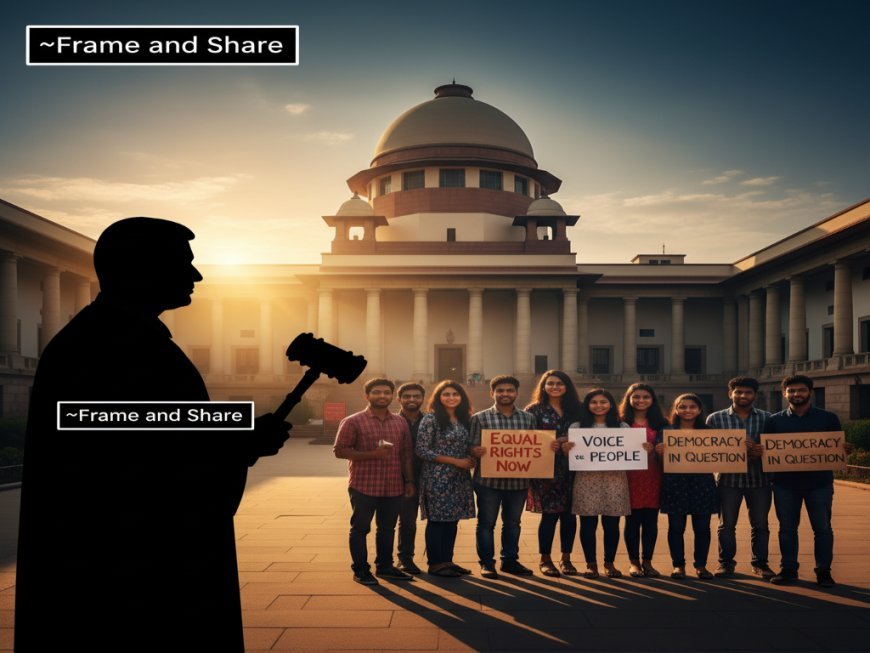


In a significant legal development that has sent ripples through India's higher education sector, the Supreme Court of India has commenced hearings on a Public Interest Litigation (PIL) challenging the University Grants Commission’s (UGC) newly notified anti-discrimination guidelines. The controversy centers on the "Equity Guidelines" introduced by the UGC, which mandate the formation of specific committees in universities to address discrimination.
The hearing, held on January 29, 2026, witnessed sharp observations from the Chief Justice of India (CJI), who questioned the very nature of these rules. With the CJI remarking, "Are we going in the reverse direction?" the court has signaled a deep concern regarding the potential for misuse and the structural bias these rules might inadvertently introduce against students from the general category.


The Core Controversy: What Are the New UGC Rules?
The University Grants Commission, the apex body for higher education in India, recently rolled out a new framework aimed at curbing caste-based and identity-based discrimination on campuses. The central feature of these regulations is the mandatory constitution of "Equity Committees" (Samanta Samiti) in all higher educational institutions (HEIs).


According to the notification, these committees must have representation from specific marginalized communities, including Other Backward Classes (OBC), Scheduled Castes (SC), Scheduled Tribes (ST), women, and persons with disabilities. The objective, ostensibly, is to provide a safe mechanism for students from these backgrounds to report harassment or bias.
However, the contention arises not from the protection of vulnerable groups, but from the exclusionary language of the guidelines. Critics and petitioners argue that the rules create a binary where students from reserved categories are permanently cast as "potential victims," while students and faculty from the general category are implicitly treated as "permanent perpetrators."
The Petitioner’s Argument: Institutionalizing Reverse Discrimination
The PIL filed before the Supreme Court argues that the new regulations violate the fundamental principles of equality enshrined in the Constitution. The petitioners contend that by creating a grievance redressal mechanism that is exclusive to specific identities, the UGC has effectively barred general category students from seeking similar redressal under this specific framework if they face harassment.
Key arguments raised in the plea include:
-
Exclusionary Protection: The rules allegedly fail to account for scenarios where a general category student might be the victim of harassment or discrimination, leaving them without a dedicated platform.
-
Presumption of Guilt: The structure of the Equity Committees, according to the plea, operates on a presumption that discrimination flows only in one direction from the privileged to the marginalized. The petitioners argue this ignores the complex, multi-layered reality of modern campus dynamics.
-
Vague Procedures: Legal experts representing the petitioners highlighted the lack of a clear investigative procedure, raising fears that the committees could be weaponized to settle personal scores or stifle academic rigor under the guise of anti-discrimination.
Judicial Scrutiny: "Are We Going in the Reverse Direction?"
The highlight of the proceedings was the oral observation made by the Chief Justice of India. Acknowledging the gravity of the issue, the Bench expressed apprehension that the regulations, in their current form, could be counter-productive.
"These rules could be misused. Are we going in the reverse direction?" the CJI remarked, hinting that instead of fostering an inclusive environment, the rules might deepen the divide between communities on campus. The Court’s "immediate hearing" decision underscores the urgency of the matter, given that universities across the country are in the process of implementing these directives.
The Bench has sought a detailed response from the UGC and the Central Government, asking for clarification on the safeguards installed to prevent the abuse of these provisions.
Government and UGC Stance: Assurance of Fairness
Facing backlash, the government has attempted to allay fears. Union Education Minister Dharmendra Pradhan has publicly stated that the intent of the government is not to harass any specific community but to ensure that campuses remain inclusive spaces.
The UGC's defense rests on the historical necessity of affirmative action. They argue that despite decades of reservations, caste-based discrimination remains a grim reality in many educational institutions, necessitating a specialized framework. The government is expected to argue that these committees are affirmative measures protected under Article 15(4) of the Constitution, which allows the state to make special provisions for the advancement of socially and educationally backward classes.
However, the government will now have to demonstrate to the Supreme Court that these "special provisions" do not infringe upon the basic rights of others or violate the basic structure of equality.
Student Unrest: Protests Erupt Across Campuses
The legal battle in the Supreme Court is mirrored by unrest on the ground. Following the notification of the rules, protests have broken out in several major universities. On Wednesday, the Arts Faculty of Delhi University became the epicenter of these demonstrations.
Students from the general category, organizing under various banners, chanted slogans against what they termed "draconian laws." Their primary grievance is that the rules create a hostile environment where false accusations could ruin careers without due process.
"We want a campus free of discrimination, but that includes discrimination against us too," stated a student leader from Delhi University. "If a committee is formed, it should be neutral. It cannot be biased in its very constitution."
Conversely, student groups representing OBC and SC/ST interests have welcomed the UGC's move, citing a long history of institutional bias and the need for a body that specifically understands their lived experiences. This polarization on campus is precisely what the Supreme Court appears to be wary of.
The Road Ahead: A Constitutional Balancing Act
The Supreme Court’s intervention comes at a critical juncture. The Indian judiciary has long performed a delicate balancing act between upholding affirmative action (reservation) and ensuring the fundamental right to equality for all citizens.
This case is likely to set a precedent on how far the state can go in regulating social interactions within educational institutions. If the Court strikes down or stays the rules, it will be a major setback for the UGC’s diversity agenda. If it upholds them, it may mandate significant amendments to introduce safeguards against misuse a "middle path" often preferred by the judiciary in such sensitive matters.
As the hearing continues, millions of students, faculty members, and parents wait with bated breath. The verdict will decide whether India’s campuses will be governed by laws that emphasize our distinct identities or laws that strive to bridge them.