
The Self-Powering Scavenger: Meet the UK's Robotic Fish That 'Eats' Plastic to Survive
Researchers at the University of Surrey have unveiled a revolutionary bio-inspired robotic fish that hunts microplastics and converts waste into energy via a synthetic stomach. Discover how this self-powering innovation could solve the ocean's pollution crisis.
 frame and share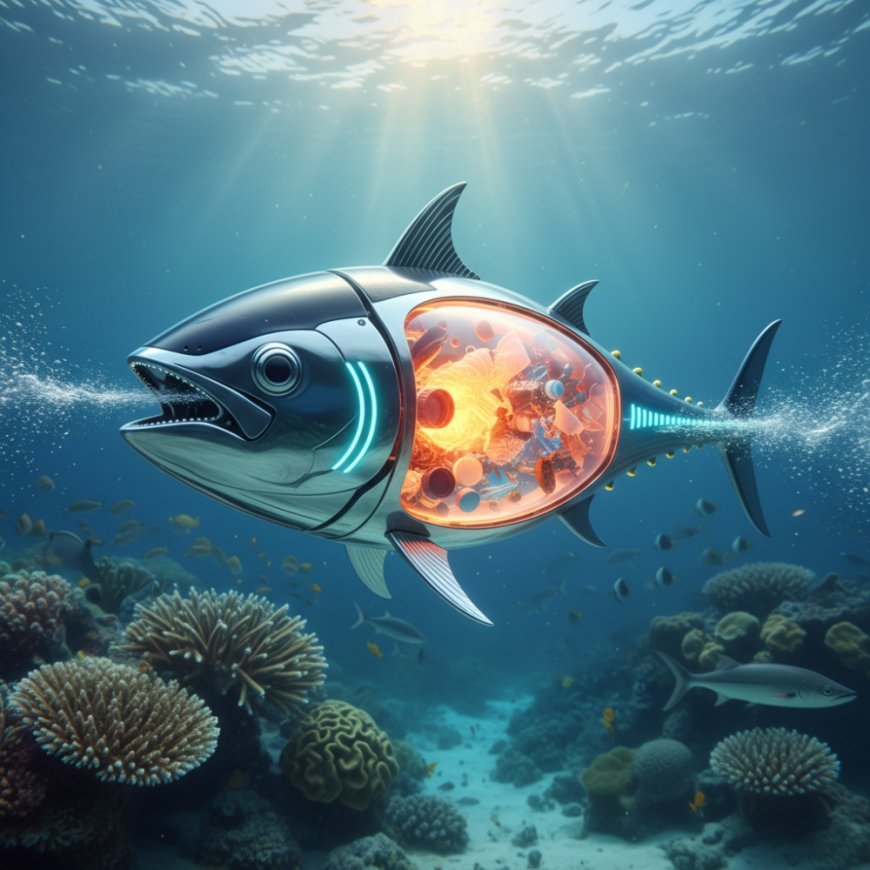


A New Predator in the Ocean
In the murky battle against ocean pollution, humanity has deployed nets, massive floating booms, and volunteer crews. But the enemy microplastics is small, pervasive, and incredibly difficult to catch. Now, researchers in the United Kingdom have unveiled a weapon that doesn't just fight pollution; it feeds on it.
A team of engineers and scientists at the University of Surrey has developed a groundbreaking bio-inspired robotic fish designed to hunt down microplastics in marine environments. Unlike its predecessors, which rely on limited battery life or external charging docks, this new iteration features a revolutionary "synthetic stomach." This internal system breaks down the very plastic it collects and converts it into usable energy, effectively allowing the robot to swim indefinitely as long as there is trash to consume.


The Design: Biomimicry at Its Best
The robot, often referred to by the nickname "Gillbert" in its earlier prototype stages, is a marvel of biomimicry the practice of modeling technology on nature’s biological processes.


1. Fluid Movement
Traditional underwater vehicles (AUVs) often use propellers, which can be noisy, energy-inefficient, and disruptive to marine life. The Surrey team’s robot uses an undulating tail mechanism, mimicking the swimming motion of a salmon. This allows it to:
Gliding Efficiency: Move smoothly through the water with minimal drag.
Eco-Friendly Presence: Blend naturally into the marine ecosystem without startling fish or disturbing delicate coral reefs.
Precise Maneuverability: Navigate tight spaces in coral reefs or riverbeds where microplastics often accumulate.
2. The Gills
The robot is equipped with a unique set of "gills" that function as a filtration system. As the fish swims, water flows over these gills, which are lined with a fine mesh. This mesh captures microplastic particles tiny fragments smaller than 5mm while allowing clean water to pass through, much like a real fish extracts oxygen.
The Game Changer: The Synthetic Stomach
The defining feature of this new robot, and what separates it from every other ocean-cleaning device currently in existence, is its energy source.
The Energy Problem
Most autonomous marine robots have a "leash" they must return to a boat or shore to recharge. This limits their range and the duration of their missions. A robot that runs out of battery in the middle of the Pacific Garbage Patch is just more space junk.
The Solution: Waste-to-Energy
The University of Surrey researchers have integrated a synthetic stomach into the robot's chassis. This system acts as a miniaturized bioreactor or microbial fuel cell.
Digestion: Once the microplastics are filtered by the gills, they are moved into an internal chamber.
Conversion: Inside the chamber, specific enzymes or bacteria break down the chemical bonds of the plastic polymers.
Power Generation: This breakdown process releases energy, which is harvested to charge the robot’s internal capacitors.
This "self-powering" loop creates a paradoxical benefit: the more polluted the water, the more energetic the robot becomes. It transforms the robot from a battery-draining device into a self-sustaining scavenger.
Why This Matters: The Microplastic Crisis
To understand the importance of this invention, one must understand the scale of the threat.
Pervasiveness: Microplastics have been found in the deepest trenches of the ocean and inside the human bloodstream.
The Food Chain: Small fish eat microplastics; bigger fish eat small fish; humans eat the big fish. We are essentially eating our own trash.
Difficulty: Traditional cleanup methods target large debris (bottles, bags). Microplastics are like a smog in the water—almost impossible to scoop up with nets without catching plankton and small fish.
The robotic fish solves this by working at the micro-level, targeting the "invisible" pollution that other systems miss.
The Future of Autonomous Cleaning
The vision for this technology is not just a single robot, but a "school" of them. Researchers envision releasing swarms of these autonomous fish into heavily polluted rivers, lakes, and coastal waters.
1. Zero Human Intervention
Because they power themselves, these robots wouldn't need a human crew to manage them daily. They could be deployed and left to "graze" on pollution for months or even years.
2. Data Collection
Beyond cleaning, these robots can serve as mobile sentinels. Equipped with sensors, they could map pollution hotspots, monitor water temperature, and track acidity levels, sending valuable data back to scientists via satellite whenever they surface.
3. Scalability
The bio-inspired design is relatively low-cost to manufacture compared to massive industrial cleaning ships. This makes it a viable solution for developing nations that face the brunt of riverine plastic pollution.
The robotic fish from the University of Surrey represents a turning point in environmental engineering. It moves past the idea of simply "cleaning up" nature and embraces the concept of working with nature's designs to heal it. By turning our waste into its fuel, this mechanical scavenger offers a glimpse of a future where our technology is as resilient and self-sustaining as the ocean it seeks to protect.