Knee Pain Relief: Why Targeted Strength Training Beats Swimming and Pilates
Are you suffering from knee pain? Forget expensive Pilates classes or swimming laps. New insights reveal that simple, targeted strength training on land is the most effective way to heal. Learn the easy home routine that works.
 frame and share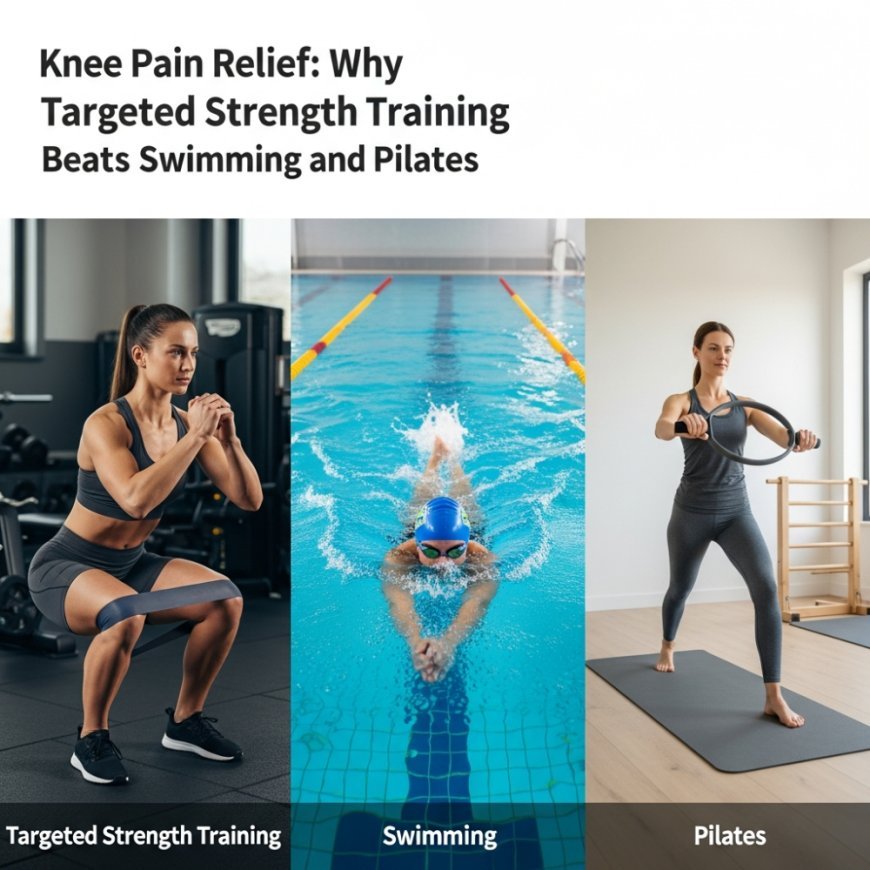


Forget Swimming and Pilates: This "Boring" Activity is the Real Cure for Knee Pain
Dublin/London: If you walk into a physiotherapy clinic on any given evening, you will see the same frustrated faces. There is the woman who finds swimming laps incredibly boring, and the man who tried Pilates only to end up feeling sore and ridiculous. They all share one common plea: "I just want to move without hurting."




For years, the standard advice for knee pain whether caused by osteoarthritis or wear and tear—has been to "go easy" on the joints. Doctors and friends alike recommend low-impact activities like swimming or gentle Pilates. While these activities aren't bad for you, a growing body of evidence suggests they aren't the best solution for fixing the root cause of knee pain.
According to recent expert analysis, the most effective activity for saving your knees is hiding in plain sight. It isn't trendy, it doesn't require a pool, and you don't need an expensive gym membership. The secret weapon? Targeted strength training on land.
The "Use It or Lose It" Reality
There is a common misconception that knees simply "wear out" like the tires on a car, and that exercising them will only make it worse. However, the reality is often the opposite. Knees frequently give up because the support system around them the muscles gave up first.
When your quadriceps (thigh muscles), hamstrings, glutes, and calves are weak, they cannot do their job as shock absorbers. This forces your knee joint, ligaments, and cartilage to take the full impact of every step you take.
While swimming is great for cardio, it doesn't always provide the "load" or gravity-based resistance needed to stimulate muscle growth and bone density around the knee. Similarly, while Pilates is excellent for the core, general classes may not target the specific leg muscles needed to stabilize a wobbly knee.
The "Boring" Routine That Works
The most effective treatment is often the least glamorous. It involves simple, controlled movements done right in your living room.
Take the case of Julie, a 48-year-old patient mentioned in recent reports. She had tried everything: breaststroke (which actually hurt her knees due to the kicking motion), YouTube Pilates, and even running. Nothing worked until her physio gave her a list of six basic strength moves.
Within three weeks, she could stand up from her couch without using her hands. Within two months, she was walking 30 minutes a day pain-free.
How to Build Your Own Knee-Saving Routine
You don't need heavy weights or a bodybuilder's physique. You just need consistency. Experts recommend starting with a simple routine performed 2-3 times a week.
The Golden Rules:
Start Slow: Do not rush. The goal is to feel effort in the muscle, not sharp pain in the joint.
Consistency Over Intensity: Two decent sessions a week are better than one "heroic" workout that leaves you limping for days.
Progression: As you get stronger, make the move slightly harder (e.g., a deeper bend or adding a resistance band).
The 5 Essential Moves:
Mini Squats: Hold the back of a sturdy chair for balance and bend your knees slightly, keeping your back straight.
Glute Bridges: Lie on your back with knees bent and lift your hips toward the ceiling.
Straight-Leg Raises: While lying down or sitting, lift one leg straight up to engage the thigh muscle.
Step-Ups: Use a low step (or the bottom stair) and slowly step up and down, holding a railing for safety.
Calf Raises: Stand facing a wall for balance and lift your heels off the ground.
Aim for 2 sets of 8–12 repetitions for each exercise.
Changing Your Mindset
The biggest benefit of strength training isn't just physical—it's mental. Chronic pain makes us fear movement. Every twinge feels like a warning sign. But as you strengthen the muscles, you begin to trust your legs again.
You stop being a passive victim of "bad knees" and become an active participant in your recovery. You might choose the stairs instead of the elevator, not to show off, but because you know your legs can handle it.
So, you can keep your Pilates membership if you love it, and stay in the pool if the water relaxes you. But if you want to fix the pain for good, add the quiet, unglamorous work of strength training to your week. It’s the difference between "I can't do that" and "I forgot my knees used to hurt."
FAQ (Frequently Asked Questions)
Q1: Is swimming bad for knees? Ans: No, swimming is not "bad." It is excellent for general fitness. However, because it is non-weight-bearing, it doesn't strengthen the muscles and bones around the knee as effectively as land-based strength training. For some, the "frog kick" in breaststroke can actually irritate the knee.
Q2: Will strength training make my osteoarthritis worse? Ans: Generally, no. Studies show that strengthening the muscles around the joint relieves pressure on the arthritis. However, you must start slowly. If you feel sharp pain (not just muscle fatigue), stop and consult a professional.
Q3: How long until I see results? Ans: While you might feel stronger in 2-3 weeks, significant reduction in daily pain usually takes about 6-8 weeks of consistent practice (2-3 times per week).
Q4: Do I need gym equipment? Ans: Absolutely not. The most effective routine uses body weight, a chair, a wall, and perhaps a simple resistance band. Consistency is far more important than equipment.