
Mahindra BE 6e Fire: Probe Blames Deflated Tyre, Rules Out Battery
Mahindra releases official investigation details on the BE 6e electric SUV fire in Uttar Pradesh. Probe confirms the EV battery was intact; negligence and a deflated tyre sparked the blaze. Read the full report.
 frame and share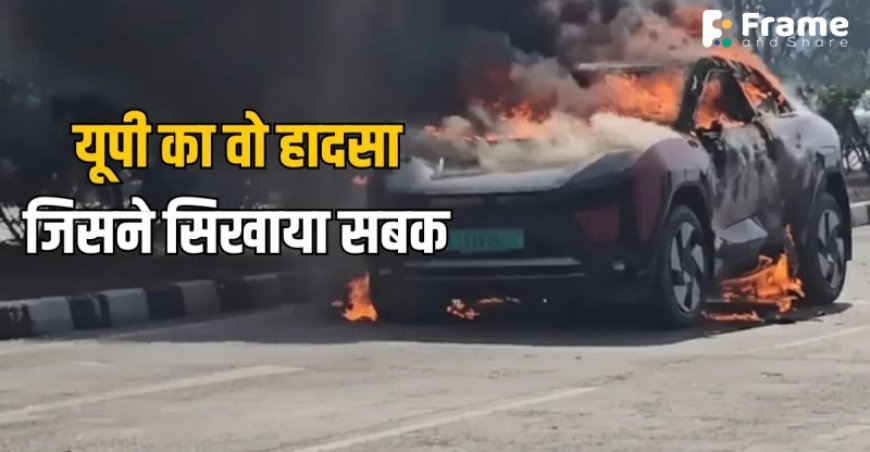


In a startling incident that briefly shook public confidence in electric vehicle (EV) safety, a brand-new Mahindra BE 6e electric SUV was engulfed in flames on a highway in Uttar Pradesh. The visuals of the burning red SUV near the Gulaothi/Kurana Toll Plaza in Hapur district went viral instantly, reigniting the debate on the reliability of EV batteries.
However, a swift and detailed investigation by Mahindra & Mahindra has brought a surprising twist to the narrative. Contrary to initial fears of a "thermal runaway" or battery explosion common concerns with EVs the probe has conclusively ruled out the high-voltage battery and electric motor as the culprits. Instead, the investigation points to a mechanical failure induced by human error: driving on a flat tyre.


The Incident: What Happened?
On a Sunday afternoon, a Mahindra BE 6e (registration number UP 13U 7555) was traveling from Bulandshahr to Hapur. Near the Kurana Toll Plaza, smoke began billowing from the rear of the vehicle, quickly turning into a massive blaze that consumed the car. Fortunately, the driver, Aman Kharbanda, and all other occupants managed to exit the vehicle safely without any injuries.


Local police from the Hafizpur station and fire tenders rushed to the spot, eventually controlling the fire, but the vehicle sustained significant damage. The viral nature of the footage led to immediate speculation about the safety of Mahindra’s new "Born Electric" platform.
The Investigation: Data Tells the True Story
Mahindra’s technical team conducted a comprehensive on-site inspection, supplemented by real-time data logs from the vehicle’s onboard computer. The findings paint a clear picture of negligence rather than a manufacturing defect.
1. The "Flat Tyre" Theory Confirmed The investigation revealed that the fire originated from the rear right tyre. Vehicle data logs indicate that the SUV was driven for over 10 minutes at speeds of approximately 60 km/h on a fully deflated rear right tyre.
2. Ignored Warnings Modern EVs are often described as "computers on wheels," and the BE 6e is no exception. The system reportedly issued multiple Tyre Pressure Monitoring System (TPMS) alerts and "high-temperature" warnings to the driver. Despite these critical red flags flashing on the digital instrument cluster, the vehicle was kept in motion.
3. Friction, Not Voltage Driving a heavy electric SUV on a flat tyre creates immense friction between the rubber, the metal wheel rim, and the tarmac. This friction generated extreme heat, eventually reaching the flashpoint of the tyre rubber, causing it to ignite. Analysis of bystander videos corroborated this, showing the fire starting specifically at the rear right wheel well before spreading to the rest of the body.
Battery and Motor: Safe and Intact
The most significant finding for the EV industry is the status of the battery pack. Mahindra’s official statement emphasized that the high-voltage battery pack and the electric motor remained completely intact and unaffected by the fire.
-
No Thermal Runaway: The battery cells did not explode or catch fire from the inside.
-
Safety Parameters: Post-incident diagnostics showed that the battery health parameters and individual cell voltages remained within safe, specified limits.
-
System Intervention: The vehicle’s Electronic Stability Program (ESP) and Traction Control System (TCS) were actively working to control the wheel spin caused by the flat tyre, proving the software was functioning correctly until the very end.
Mahindra's Official Statement
In a bid to maintain transparency and quell rumors, Mahindra issued a strong clarification:
"We are aware of the recent incident involving a Mahindra BE 6e vehicle near Gulaothi. Based on a thorough on-site investigation combined with onboard sensor data and software diagnostics, we confirm that the EV battery and motor remain fully intact and unaffected. Vehicle data confirms that the car was driven for over 10 minutes on a fully deflated rear right tyre, despite repeated alerts. The fire was caused by excessive friction and heat buildup from external sources (tyre rubber), not the powertrain."
The company also reiterated that the vehicle’s safety protocols including speed limitation and eventual system shutdown—triggered correctly, bringing the car to a halt and allowing passengers to escape unharmed.
The Broader Lesson: EV Safety and Awareness
This incident serves as a critical case study for EV ownership in India. While manufacturers are responsible for building safe cars, drivers play an equal role in maintaining safety.
-
Heed the Warnings: Unlike mechanical cars where you might "feel" a flat tyre, modern EVs with advanced suspensions might mask the sensation. This makes paying attention to dashboard alerts non-negotiable.
-
Don't Push the Limits: Driving on a flat tyre is dangerous in any vehicle, but in an EV, the high torque and weight can escalate the situation rapidly, as seen in this case.
The fire that destroyed the Mahindra BE 6e was a result of a "perfect storm" of ignored warnings and mechanical friction, not a failure of electric mobility technology. While the visuals were alarming, the survival of the battery pack amidst the flames stands as a testament to the robust safety standards of India's EV sector. As the dust settles, the message is clear: the technology is safe, but it demands responsible handling.