Medical Breakthrough: Tiny "Spaghetti" Robot Could End Kidney Stone Surgery Forever
Researchers at the University of Waterloo have developed a rice-sized, magnetic soft robot capable of dissolving kidney stones without surgery. Discover how this non-invasive "spaghetti" robot uses enzymes and magnets to treat patients pain-free.
 frame and share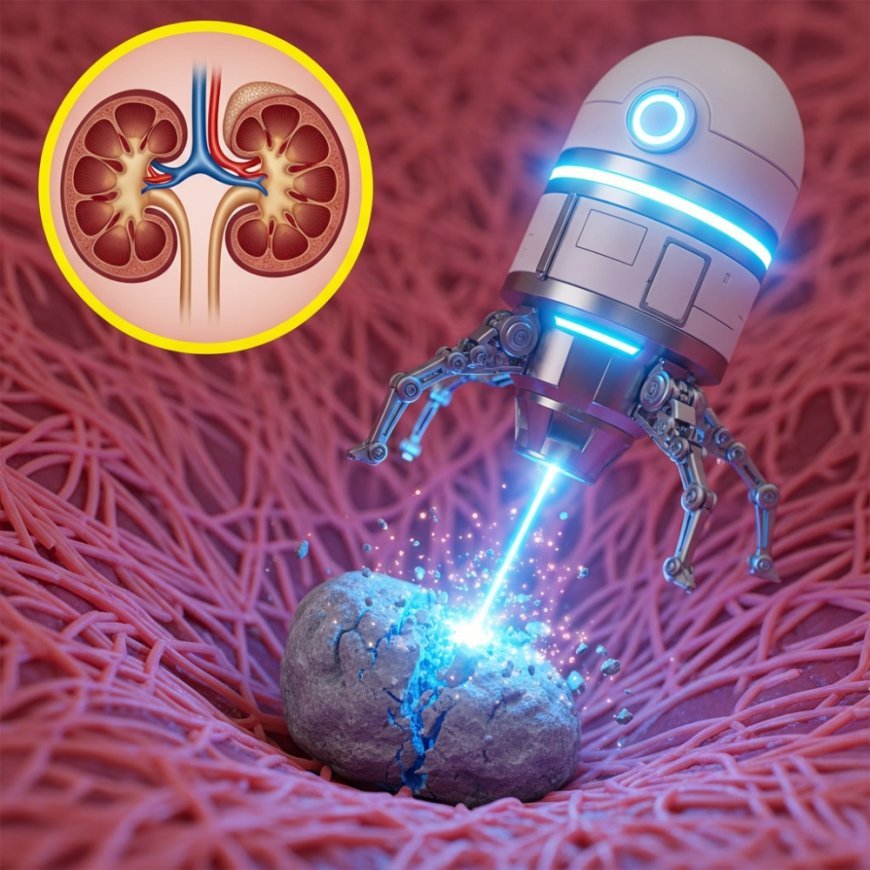


A Pain-Free Future for Kidney Patients
For the millions of people worldwide who suffer from kidney stones, the current treatment options ranging from passing the stone naturally to painful shock wave therapy or invasive surgery are often dreaded. However, a revolutionary development from the University of Waterloo in Canada promises to change the landscape of urology forever.
A team of researchers has unveiled a major medical breakthrough: a tiny, magnetic "soft robot" designed to navigate the human body and dissolve kidney stones directly, eliminating the need for incisions or general anesthesia.


The "Spaghetti" Robot: What Is It?
Unlike the metal, rigid machines typically associated with robotics, this device is a feat of bio-compatible soft robotics.


-
Size & Shape: The robot is roughly one centimeter long and shaped like a thin strip of spaghetti. Its diminutive size comparable to a grain of rice allows it to travel through narrow bodily channels.
-
Material: It is constructed from a flexible, gelatin-based hydrogel material. This flexibility is crucial, allowing it to move fluidly through the delicate urinary tract without causing friction or tissue damage.
How It Works: Magnets and Enzymes
The genius of this technology lies in its dual-action approach: it requires a unique method of transportation and a chemical payload to destroy the stone.
1. Targeted Navigation
The robot does not have an internal motor or battery. Instead, it is infused with magnetic particles. Doctors can guide the robot remotely using an external motorized magnetic arm. By manipulating the magnetic field outside the patient's body, they can steer the robot through the urethra and bladder, directly to the kidney.
To ensure precision, the team utilizes real-time ultrasound imaging to track the robot's journey, ensuring it reaches the exact location of the blockage.
2. Chemical Dissolution
Once the robot reaches the target, it begins its work. The device is loaded with urease, a specific enzyme. When released, urease triggers a chemical reaction with the urea naturally found in urine.
-
The Reaction: This interaction raises the local pH level around the stone, making the environment more basic (alkaline).
-
The Result: This change in pH is highly effective at dissolving uric acid stones. The stone gradually breaks down until it is small enough to pass naturally through the urinary tract without pain.
Unprecedented Speed and Recovery
Current non-invasive treatments, such as oral medication to dissolve stones, can take months to work. In contrast, the Waterloo team’s lab tests on 3D-printed models yielded stunning results: the soft robot successfully reduced the mass of the stones by 30% in just five days.
This method offers a "Goldilocks" solution faster than medication, but far less traumatic than Shock Wave Lithotripsy (which uses sound waves to break stones) or ureteroscopy (which requires inserting tools and stents).
Why This Matters
This discovery is a beacon of hope for the estimated 12% of the global population who suffer from kidney stones. It is particularly vital for "recurring stone formers" patients who are genetically or environmentally predisposed to developing stones repeatedly. For these individuals, repeated surgeries can lead to scar tissue and accumulated trauma.
Led by Dr. Veronika Magdanz, this project marks the first successful use of micro-robotics for the local dissolution of kidney stones. By removing the need for incisions, stents, and anesthesia, this technology could transform kidney stone removal from a major medical procedure into a simple, pain-free outpatient treatment.
Summary of Benefits
| Feature | Traditional Surgery | Soft Robot Treatment |
| Invasiveness | High (Incisions/Tools) | None (Natural entry) |
| Anesthesia | Required | Not Required |
| Tissue Damage | Risk of scarring | Safe on healthy tissue |
| Recovery Time | Weeks | Days |