CCTV Mandate Must Be Withdrawn Immediately, Says Samajwadi Party; Warns Against "Police State", Announces Fight from Assembly to Parliament.
 frame and share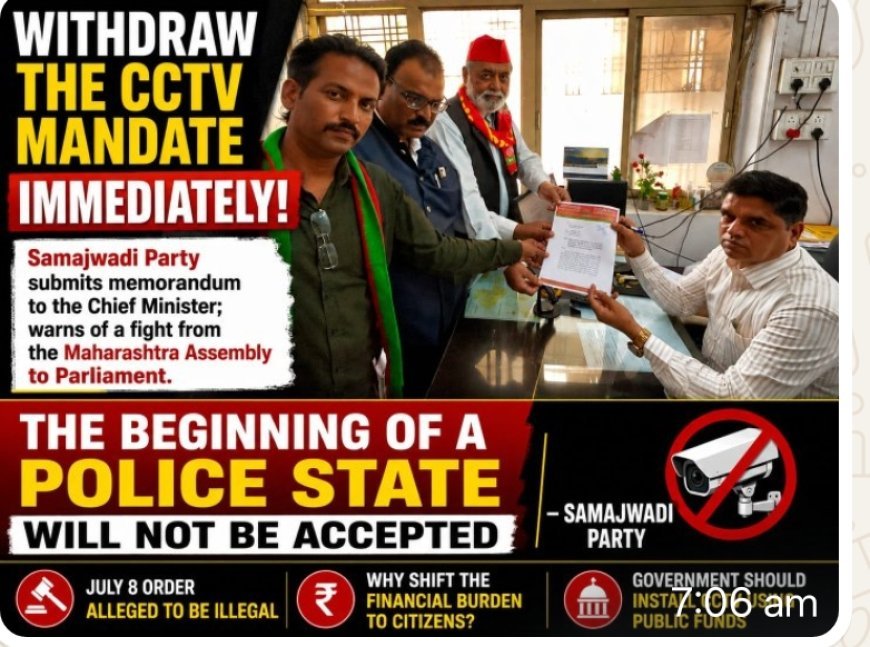


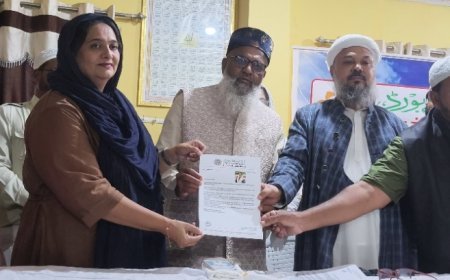
Chhatrapati Sambhajinagar, July 10: The Samajwadi Party (Maharashtra) has strongly opposed the recent order issued by the Chhatrapati Sambhajinagar Police Commissioner making the installation of CCTV cameras mandatory across a wide range of private establishments. Describing the directive as an "unconstitutional burden on citizens" and the beginning of a "police state," the party on Thursday submitted a detailed memorandum addressed to Maharashtra Chief Minister and Home Minister through the Divisional Commissioner, demanding the immediate withdrawal of the order.
The party urged the state government to revoke the notification issued on July 8, 2026, conduct a high-level inquiry into its legal validity, and prevent the financial burden being imposed on traders, institutions, and ordinary citizens in the name of public safety.


According to the memorandum, the order issued under Section 163 of the Bharatiya Nagarik Suraksha Sanhita (BNSS), 2023 compels a vast range of establishments including banks, ATMs, financial institutions, jewellery shops, hotels, guest houses, restaurants, bars, pubs, wine and beer shops, residential towers, office buildings, newly constructed buildings, petrol pumps, shopping malls, supermarkets, gyms, stadiums, cinema halls, educational institutions, religious places, hospitals, trusts and various organizations to install CCTV surveillance systems.
The Samajwadi Party argued that the directive would place an enormous financial burden running into crores of rupees on thousands of traders, commercial establishments, educational institutions, religious organizations and citizens, despite law and order being the constitutional responsibility of the State.
Government Cannot Shift Its Responsibility:
In its memorandum, the party maintained that maintaining public safety and law and order is the government's constitutional obligation and cannot be transferred to private citizens by forcing them to bear the cost of surveillance infrastructure.
The party further argued that Section 163 of the BNSS is intended only for temporary emergency situations requiring immediate preventive action. Using such emergency powers to impose a broad administrative obligation affecting the general public amounts to an abuse of statutory authority, the memorandum stated.
"If CCTV Is Essential, Government Should Pay":
The Samajwadi Party also questioned the rationale behind issuing a mandatory order that is valid for only 60 days.
"If CCTV surveillance is genuinely essential for public safety, the State Government should formulate a permanent policy and establish the required infrastructure using public funds instead of compelling private establishments to shoulder the expense," the memorandum said.
The party pointed out that installing surveillance systems, ensuring their maintenance, preserving recordings for at least 15 days, and covering a surveillance radius of 50 metres would be financially impossible for many small traders and businesses operating with limited resources.
Fear Among Citizens:
The memorandum also expressed concern over the provision stating that non-compliance with the order could attract prosecution under Section 223 of the Bharatiya Nyaya Sanhita (BNS), 2023, arguing that such penal consequences have created an atmosphere of fear among traders and citizens.
The party further criticized the administration for issuing the directive without consulting stakeholders such as trade associations, industry bodies, educational institutions, religious organizations or civil society groups before implementing a decision with far-reaching economic consequences.
Questions Raised Over Public Expenditure:
The Samajwadi Party questioned why the government had failed to install CCTV cameras at important public roads, traffic junctions and sensitive locations using state funds, while transferring the entire financial responsibility to private establishments.
It also expressed apprehension that the large-scale mandatory procurement of CCTV systems could benefit certain commercial interests, raising questions about the transparency and decision-making process behind the order.
Four Major Demands Before Government
• The memorandum urged the Maharashtra Government to:
• Immediately withdraw the Police Commissioner's order dated July 8, 2026.
• Conduct a high-level inquiry into its legal validity.
• Frame any future surveillance policy only after extensive consultation with traders, institutions and all concerned stakeholders.
• Launch a separate government-funded scheme for installing CCTV infrastructure required for public safety.
Issue to Be Raised in Assembly and Parliament:
The party warned that the issue would not remain confined to Chhatrapati Sambhajinagar.
Party leaders announced that during the ongoing Monsoon Session of the Maharashtra Legislative Assembly, both Samajwadi Party MLAs would raise the matter and seek accountability from the government.
They further declared that during the Parliament's Monsoon Session beginning on July 20, the party's 40 Members of Parliament would raise the issue at the national level and oppose what they described as policies that impose financial liabilities on citizens under the guise of public security.
"Public Safety Is Government's Duty"
Reiterating its stand, the Samajwadi Party said:
"In a democratic system, ensuring public safety is the responsibility of the government. Any attempt to build a police state by placing financial burdens on citizens will not be accepted. The administration must uphold constitutional values, democratic principles and public interest rather than shifting its responsibilities onto ordinary people."
: The memorandum was submitted at the office of the Divisional Commissioner in the presence of Dr. Sheikh Abdul Rauf (State General Secretary), Akhil Sheikh (State Secretary), Riyaz Deshmukh (State Secretary), Adv. Sheikh Gufran Ahmad, Mohammad Isa Yasin, Ayub Patel, Mirza Salman Beg, Syed Tabishoddin, Sheikh Gaus, Shaheen Pathan, and several other party office-bearers.