CCTV Mandate or the Dawn of a Police State?
 frame and share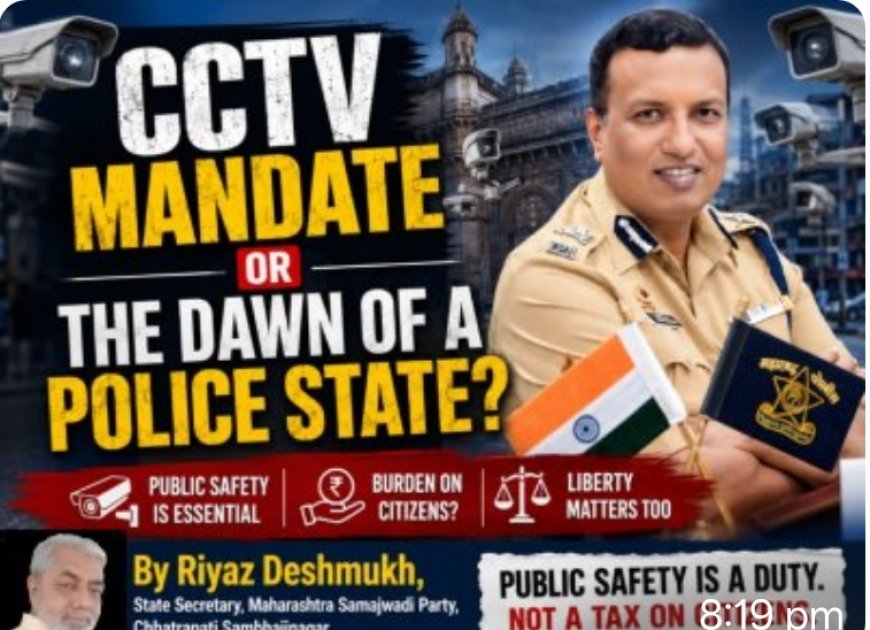


By Riyaz Deshmukh,
State Secretary, Maharashtra Samajwadi Party, Chhatrapati Sambhajinagar.(Aurangabad.)


A recent order issued by the Commissioner of Police, Chhatrapati Sambhajinagar, under Section 163 of the Bharatiya Nagarik Suraksha Sanhita (BNSS), 2023, has sparked serious public debate. While the stated objective is to strengthen public safety and improve crime detection, the order raises fundamental questions about the constitutional limits of executive power and the extent to which the State can shift its responsibilities onto private citizens.


The directive requires a wide range of private establishments—including banks, ATMs, financial institutions, jewellery shops, hotels, restaurants, bars, educational institutions, hospitals, religious places, shopping malls, petrol pumps, residential and commercial buildings, sports complexes, cinema halls, and many others—to install CCTV cameras covering areas extending up to 50 metres beyond their premises. It further mandates that these cameras remain operational round the clock, preserve recordings for at least fifteen days, provide playback and copying facilities, supply footage to the police whenever demanded, and report suspicious activities to law enforcement.
No reasonable citizen disputes the importance of public safety. CCTV surveillance has undoubtedly helped solve numerous criminal cases and can serve as a valuable deterrent against crime. The issue, however, is not whether CCTV cameras are useful. The real issue is whether the Government can compel private citizens to bear the financial and operational burden of performing what is essentially a core governmental function.
Maintaining law and order is not merely an administrative responsibility—it is a constitutional obligation of the State. Citizens are expected to cooperate with law enforcement, but cooperation cannot be transformed into compulsory expenditure through executive orders issued under emergency powers.
Equally perplexing is the temporary nature of the directive. The order remains effective for only sixty days—from 9 July to 6 September 2026. If the security situation genuinely requires city-wide CCTV surveillance, can such a challenge realistically disappear after two months? Or will similar orders continue to be issued every sixty days because Section 163 authorises restrictions only for limited periods?
Temporary executive orders cannot become substitutes for permanent public policy.
If comprehensive surveillance is genuinely necessary for urban security, the Government should formulate an appropriate legislative framework, allocate public funds, and establish a permanent surveillance infrastructure through the Police Department itself. A taxpayer-funded government cannot continuously transfer its constitutional responsibilities to taxpayers once again through private expenditure.
The order also raises serious questions of practicality. Thousands of establishments would have to procure cameras, recording systems, storage devices, electrical installations, networking equipment, and maintenance services within a short period. Has any feasibility study been conducted? Has the total financial impact been assessed? Have small businesses and charitable institutions been consulted before imposing such obligations?
The economic implications are substantial. Such a directive has the potential to generate business worth hundreds of crores of rupees for CCTV manufacturers, suppliers, distributors, installation contractors, and maintenance agencies. While commercial benefit alone does not invalidate a public policy, the scale of the resulting market inevitably invites legitimate public scrutiny regarding transparency, necessity, and proportionality.
Perhaps the most troubling aspect is the threat of criminal prosecution for non-compliance under Section 223 of the Bharatiya Nyaya Sanhita, 2023. Citizens are effectively confronted with a difficult choice: incur significant expenditure or risk criminal consequences. Such an approach risks replacing voluntary civic cooperation with compelled compliance.
Public safety must never become a justification for eroding the delicate balance between governmental authority and individual liberty.
If the Police Commissioner sincerely believes that city-wide CCTV coverage is indispensable, the appropriate course would be to recommend permanent legislation and seek budgetary support from the Government of Maharashtra and the Government of India. A democratically enacted law, backed by adequate public funding and implemented uniformly, would command far greater legitimacy than recurring temporary executive directives.
The debate, therefore, extends far beyond CCTV cameras. It concerns the constitutional boundaries of executive authority, the financial burdens imposed upon citizens without legislative sanction, and the principle that governments cannot abdicate their core responsibilities by transferring them to private individuals.
Public safety is essential. But equally essential is ensuring that measures adopted in its name remain lawful, proportionate, transparent, and respectful of democratic freedoms.
In a constitutional democracy, security and liberty must advance together—not at the expense of one another.