‘Challan Police’ vs ‘Highway Safety Police’: Is Security Being Sidelined on Maharashtra’s Samruddhi Expressway?
 frame and share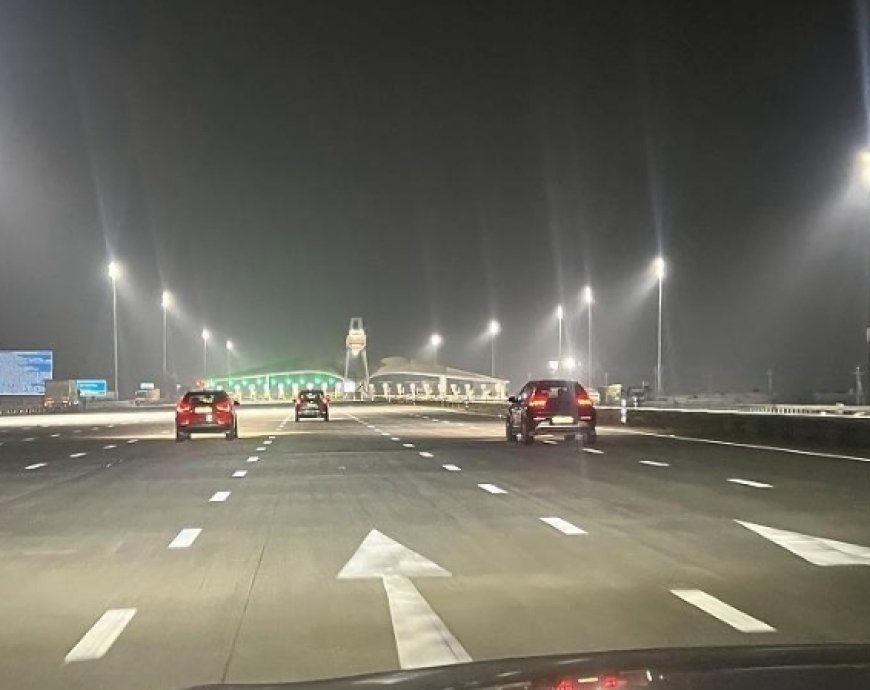


Samruddhi Expressway: A Symbol of Prosperity or a Highway of Fear?
The Samruddhi Expressway was envisioned as a symbol of Maharashtra’s development. It was promoted as a representation of speed, modernity and progress. But if vehicles are being stopped in the middle of the night and passengers are being robbed on this very expressway, then a serious question arises: Is this truly a highway of prosperity, or has it become a highway where robbers can operate with impunity?


The incident reported in the Maldhon-Dushingpur area of Sinnar taluka exposes serious shortcomings in Maharashtra’s highway security system. Sharp iron objects were allegedly placed on the road to puncture the tyres of speeding vehicles. As soon as the vehicles stopped, a masked gang reportedly surrounded the passengers and robbed them of their valuables, including gold and cash.


If such activity continued on the highway for nearly one and a half hours, the obvious question is: Where exactly were the highway police during this period?
It is time to ask this question.
And this is not merely a question concerning Sinnar. It is a question about the entire security system of the Samruddhi Expressway.
Snatching a Child From His Mother’s Lap Is Not Robbery—It Is Terror
The experience of the Mishra family is enough to send shivers down anyone’s spine.
The family was travelling by car from Chhatrapati Sambhajinagar towards Mumbai. Their vehicle was reportedly travelling at around 100 kilometres per hour when one of its tyres suddenly burst. The car stopped. The family members got out, hoping to find help.
Instead, masked robbers allegedly descended upon them.
The gang did not stop after allegedly stealing gold jewellery and cash. A small child was reportedly snatched from his mother’s lap.
For any mother or father, what could be more terrifying than such a moment?
How much money the robbers took and how many grams of gold they stole can be calculated later. But who will measure the fear that has now been permanently planted in the minds of the family members?
Should every family travelling on the Samruddhi Expressway now have to hold their children tightly and travel in fear?
Is this the kind of question that should arise about Maharashtra’s highway security system?
What Happened to the Fear of the Police?
During 1992-93, the Maharashtra government introduced the concept of Highway Safety Patrols to prevent crime on highways. Armed teams used to patrol the highways. Their very presence created fear among criminals.
Criminals knew that police personnel were present on the highway, that they were armed and that they were continuously patrolling.
Today, technology has advanced enormously.
There is GPS. There are mobile networks, CCTV cameras, e-challans, modern vehicles, control rooms and digital systems.
So the question is:
Has technology increased while highway safety has decreased?
If criminals today have the courage to stop vehicles and commit robberies on highways, what exactly have we achieved in the name of progress?
The Speed of E-Challans and the Speed of Robbers
What is the fundamental responsibility of the highway police?
Their responsibilities include maintaining smooth traffic flow, assisting accident victims, controlling traffic and ensuring that highways remain safe. They also have the authority to take action against violations under the Motor Vehicles Act.
But having authority is not the same as fulfilling responsibility. And issuing challans is not the same as ensuring highway security.
Where does an ordinary citizen see highway police today?
Often while checking vehicles. While issuing challans. While taking action against traffic violations.
But how often does a citizen see armed police teams continuously patrolling the highway at night, ready to reach a stranded vehicle in an emergency?
The highway police and the state government must answer this question.
If a perception has developed among citizens that challan collection is being given greater priority than their safety, then it is also the responsibility of the police to remove that perception.
If there are allegations of legal or illegal collection of money against highway police personnel, those allegations are serious and must be investigated. If anyone is found guilty, strict action should follow.
At the same time, it would also be wrong to make sweeping allegations against all highway police personnel. A transparent investigation is necessary to ensure that honest officers who are performing their duties are not unfairly defamed.
But one thing must be clear:
The primary enemy of the highway police should not be the law-abiding traveller or merely the traffic violator. It should be the criminals operating on the highway.
That is where the priority must lie.
Highway Aid Posts or Police Outposts in Name Only?
A Traffic Aid Post is supposed to represent a promise of help to citizens in distress.
But if a family’s car breaks down at an isolated location late at night, how quickly can help reach them?
What happens if a tyre bursts?
What happens in an accident?
What happens if a family is surrounded by armed robbers?
The real test of a highway security system comes at precisely such moments.
It is not enough to ask how many police outposts exist. What matters is how quickly a patrol team can move from that outpost to a citizen in distress.
A police vehicle merely standing on the highway does not constitute security.
Reaching a citizen quickly during an emergency—that is security.
Samruddhi Needs at Least Six Armed Patrol Teams
The government must now move beyond announcements and meetings and take concrete action.
A comprehensive security audit of the entire Samruddhi Expressway should be conducted, and at least six independent, armed highway security patrol teams should be deployed.
These teams should not simply sit inside police posts.
Their primary responsibility should be 24-hour highway patrolling.
Every patrol vehicle should be connected to GPS. The location of every team should be visible to the control room. There should be a digital record showing which team patrolled which stretch and for how long.
If there is a break in patrolling, senior officers should receive an immediate alert.
Whenever a crime takes place, the system should record how many minutes the nearest patrol team took to reach the location.
Patrolling should not remain a matter of paperwork. It should be a reality that can be verified through GPS.
Armed Teams Must Be Properly Trained
Highway security teams should have appropriate weapons and equipment. They should consist of trained personnel and operate under clearly defined rules, supported by regular drills.
Providing weapons does not mean giving police officers unrestricted authority to open fire.
On the contrary, officers must receive rigorous training on exactly when and under what legal circumstances firearms may be used.
If robbers surround passengers and an armed police team reaches the scene, criminals must know that the police can legally and effectively resist them.
A security system in which robbers have the courage to attack while police are left holding nothing more than challan machines cannot be allowed to continue.
The police uniform should give citizens confidence.
When motorists see an armed police patrol in uniform on the highway, they should have one immediate feeling:
“We are safe.”
That sense of security needs to be restored.
The primary identity of highway police should not be “police who issue challans” but “police who keep highways safe.”
Their performance evaluation must change accordingly.
Instead of asking how many challans an officer issued in a month, authorities should ask:
How many kilometres did the officer patrol?
How many stranded vehicles were assisted?
What was the average response time to emergencies?
How many crimes were prevented?
How many suspicious activities were detected?
The report card of highway police should be based not on the number of challans issued, but on the safety of citizens.
Who Is Responsible When a Robbery Takes Place?
This is the most difficult question.
The crime belongs to the robbers. Catching them is the responsibility of the police.
But if crimes are repeatedly taking place in a particular area, if vehicles are being deliberately disabled by dangerous methods, and if sufficient police patrolling is still absent from that area, then the shortcomings in the security system must also be investigated.
When a crime takes place on a highway, merely registering an FIR and closing the matter cannot be considered sufficient.
Authorities must examine:
Where was each patrol team at the time?
Where were they patrolling?
What information did the control room have?
How quickly was the emergency call received?
How quickly did the police reach the location?
Why was the nearest patrol team not alerted?
All these questions must be investigated.
If it is established that negligence or shortcomings in the security system created an opportunity for criminals, administrative responsibility must also be fixed.
The Government Must Guarantee Safety, Not Just ‘Samruddhi’
Citizens travelling on the Samruddhi Expressway pay tolls.
In return, it is not enough to provide them with a good road.
They must also receive the confidence of a safe journey.
If the road is modern and impressive but criminals can freely operate on it, then what is the meaning of that prosperity?
At the time of inaugurating highways, grand lights are installed. Development signboards are erected. The language of speed and progress dominates the discussion.
Now it is time to install the lights of security on the same highway.
The government must immediately:
Conduct an independent security audit of the Samruddhi Expressway.
Identify vulnerable locations and increase armed patrolling in those areas.
Consider deploying at least six independent armed security patrol teams.
Make GPS tracking mandatory for all patrol vehicles.
Monitor every patrol vehicle from a central control room.
Make effective use of CCTV, ANPR and other available technologies.
Audit the response time for every serious incident.
Evaluate highway police performance based on safety and emergency response rather than merely the number of challans issued.
Conduct impartial inquiries into allegations of illegal or improper collection of money involving highway police personnel.
Convert Traffic Aid Posts into genuine emergency response centres.
Most importantly, bring “security” back to the centre of highway policing.
The Final Question for the Government
Masked robbers allegedly create havoc on the Samruddhi Expressway in the middle of the night for nearly one and a half hours.
Three vehicles are targeted.
One family is robbed.
A child is snatched from his mother’s lap.
Gold jewellery and cash are taken.
Even then, the question cannot simply be:
“Who were the robbers?”
The equally important question must be:
“Where was the highway security system at that time?”
Because catching the robbers is the duty of the police.
But ensuring that criminals do not get a free hand on the highway is the responsibility of the security system.
Every family travelling on the Samruddhi Expressway deserves one clear message from the government:
“No matter how fast you are travelling or where your vehicle stops, Maharashtra Police will reach you before the crisis becomes a catastrophe.”
Until that confidence is restored, the shine of the Samruddhi Expressway remains incomplete.
Because a highway where the safety of citizens is not secure has no moral right to be called a “Samruddhi” highway of prosperity.
There should be no fear of robbers on the highway.
There must be fear of the law.
This does not mean that police should stop issuing challans. But before enforcing traffic rules, citizens must be protected and lives must be saved.
The Samruddhi Expressway now needs, above all, a strong security shield.