
Iran Develops ‘Living Biological Intelligence’: Lab-Grown Brain Uses 10 Lakh Times Less Power Than Supercomputers.
 frame and share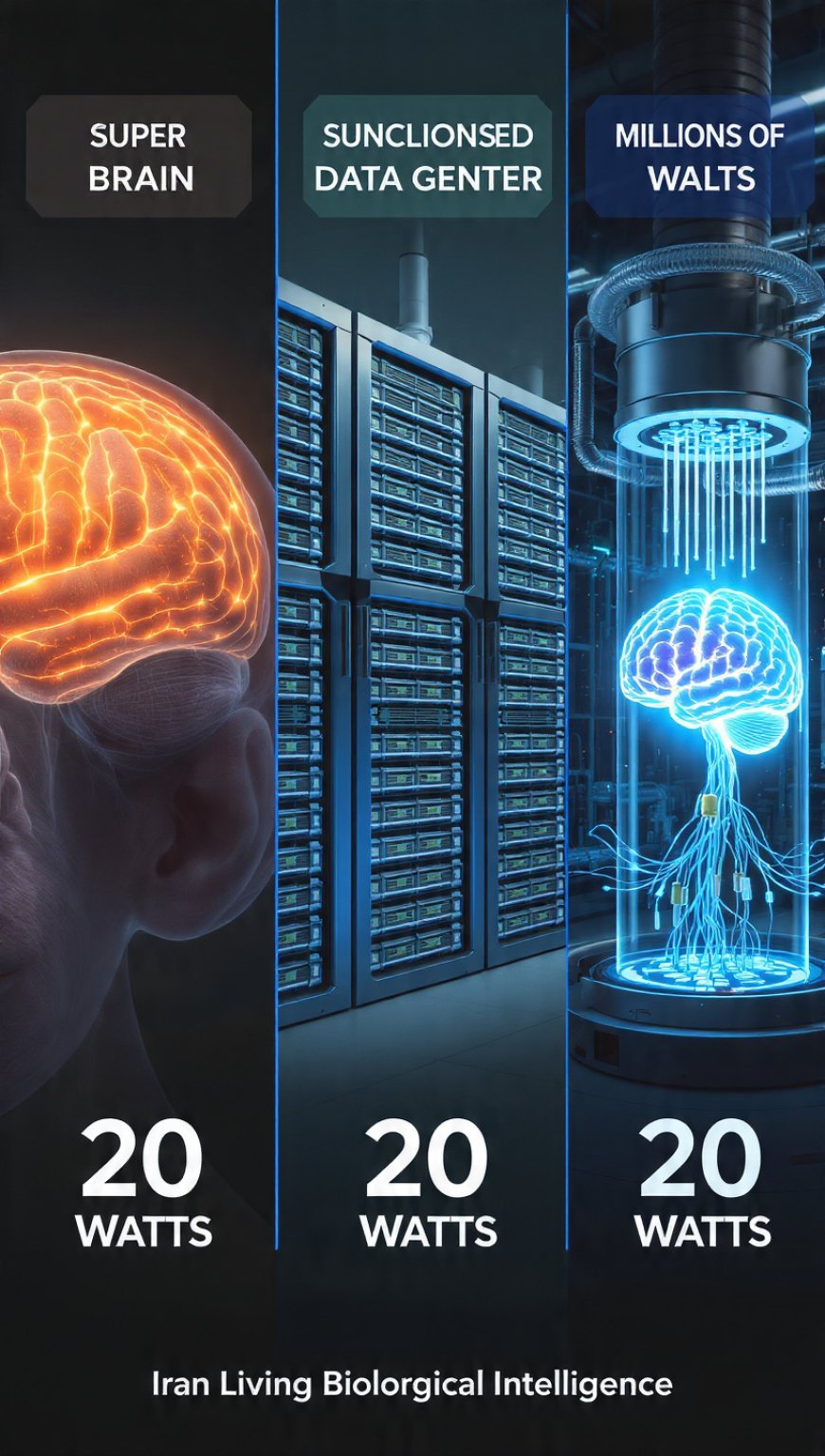


‘Wetware’ Revolution? Iran Builds Living Neural Network That Learns, Thinks Like Humans on Just 20 Watts.
Tehran:-


What’s the Claim?


According to the Hindi News18 report, Iranian researchers have developed a “living biological intelligence”an artificial brain made from lab-grown human neural tissue that “thinks like humans” and consumes 10 lakh (1 million) times less power than conventional supercomputers.
The system uses brain organoids 3D clusters of neurons derived from human stem cells grown in nutrient-rich gels. These “mini-brains”form synaptic connections and basic neural circuits, mimicking key aspects of the human cerebral cortex.
How Does ‘Biological AI’ Work?
Unlike traditional AI that runs on silicon chips, this approach uses “wetware”living neurons as the computing hardware:
Neurons on a chip: Organoids with 800,000 cells are connected to high-density microelectrode arrays (MEAs) that deliver stimuli and record electrical activity.
Learns via biofeedback: AI algorithms treat the organoid as a “dynamic reservoir”, processing inputs through real neural spiking activity.
Ultra-low power: The human brain runs on just 20 watts over 1 million-fold less than the world’s largest supercomputer, which still doesn’t match human intelligence. 9afdcbad
Why It Matters.
Energy crisis in AI: Conventional AI infrastructure consumes “vast and growing resources, particularly electricity and water”, with significant climate impacts. Data centers already use massive power, and “digital computing is on track to overwhelm the grid”
Brain-inspired efficiency: Biological brains integrate memory and processing in the same place, unlike digital computers that shuttle data between CPU and RAM. Neuromorphic and biocomputing approaches could cut energy use by 70%.
Global Context: The ‘Organoid Intelligence’ Race.
Iran joins a small group pioneering biocomputing/organoid intelligence:
Final Spark (Switzerland): Uses “neurospheres” with 10,000 neurons for 100 days, aiming to teach them tasks via electrodes.
Cortical Labs (Australia) & Koniku (US): Other firms building “thinking computers” with living neurons.
Northwestern University: Developed “synaptic transistors” and printed neurons that fire like real brain cells and can activate mouse neurons.
Dr. Fred Jordan of Final Spark said: “The way the brain processes information is incredibly intricate, and today’s digital computers simply aren’t up to the task… let’s revolutionize it with living neurons or ‘wetware’.”
Limitations & Ethics.
These aren’t full brains organoids have 800,000 cells vs 86 billion in a human brainand are not conscious. Current prototypes like Final Spark’s can only “store 1 bit of information”.
Researchers emphasize organoids are “simplified sandboxes of the human mind”, grown from ethically sourced stem cells.
If verified, Iran’s system would be part of a global shift toward biological computingbto solve AI’s energy problem. The human brain’s 20-watt efficiency is the gold standard scientists are chasing whether with silicon mimics or actual living neurons. But passing the Turing test with “wetware” remains unsolved.
The original Hindi News18 article could not be fully accessed. Summary based on available details + global research context on biocomputing and organoid intelligence.