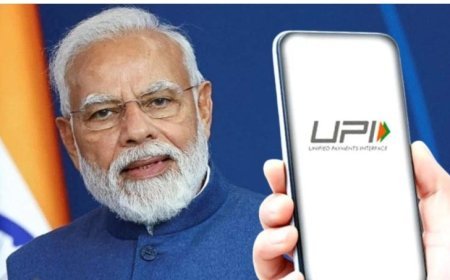
0.4% UPI Fee on Payments Above ₹2,000: Centre Plans Daily Checks to Protect Consumers
 frame and share

New Delhi: The Centre is preparing to monitor the implementation of the new Merchant Discount Rate (MDR) on certain UPI transactions on a daily basis from October 15, 2026, with the stated aim of ensuring that merchants do not transfer the additional cost to consumers.
Under the revised framework announced by the National Payments Corporation of India (NPCI), a 0.4% MDR will apply to specified person-to-merchant (P2M) UPI transactions above ₹2,000 from October 15. The charge will generally be borne by merchants rather than customers.


Finance Ministry officials have said the government is holding discussions with payment aggregators, banks and merchant-onboarding platforms to ensure that the new fee is implemented as intended. The monitoring mechanism will examine whether merchants are attempting to recover the MDR by adding separate charges to customers' bills. �


mint +1
What will change from October 15?
The new MDR will apply to specified P2M UPI payments above ₹2,000. The rate is 0.4%, with a maximum MDR of ₹300 for transactions of ₹75,000 or more. For example, a ₹10,000 eligible merchant payment would attract an MDR of ₹40.
However, UPI payments between individuals will remain free, irrespective of the transaction amount. Merchant payments up to ₹2,000 will also remain outside the MDR framework, while eligible small merchants receiving up to ₹1 lakh a month through UPI QR payments will continue to receive protection under the zero-MDR framework.
The government has said that approximately 96% of P2M UPI transactions will remain unaffected by the new framework.
Special rates for essential sectors
Certain essential and thin-margin sectors will have a different structure. Transactions above ₹2,000 involving areas such as railways, telecommunications, insurance, fuel and agricultural inputs will attract a flat MDR of ₹5 per transaction, according to the government's framework. Specified capital-market transactions will attract a concessional 0.02% MDR, subject to a ₹300 cap.
The government has also clarified that MDR is not a tax collected by the government or NPCI. It is distributed among participants in the digital-payment ecosystem, including banks and payment-service providers, to support the operation and expansion of UPI.
Why is the government monitoring the system?
The daily monitoring is intended to prevent the new merchant-side cost from becoming a hidden charge for UPI users. Officials have also indicated that the government does not expect the revised MDR structure to cause a significant shift from digital payments back to cash.
The move comes as India seeks to create a more sustainable revenue model for the UPI ecosystem while keeping ordinary consumer-to-consumer transfers free.